The Graves Amendment: Does it Shield a Taxi-Cab Company from Vicarious Liability?


untitled (13)By Greg Johnson. Does the federal Graves Amendment apply to insulate taxi-cabs from vicarious liability for the negligence of their drivers? The issue is obviously important in the twelve jurisdictions which by statute impose vicarious liability on the owner of motor vehicles for a permissive user’s negligence. In a previous post, I provided an overview of the Transportation Equity Act of 2005 (49 USC § 30106) (a/k/a “Graves Amendment”), a federal law which preempts state law imposing liability on vehicle owners engaged in the business of renting or leasing motor vehicles absent negligence on the part of the vehicle owner. (See “Leasing, Renting & Vicarious Liability: An Overview of the Graves Amendment”).

Whether the Graves Amendment applies to taxi-cabs was addressed in Kindard-Jennings v. Yellow Cab Co., 2013 WL 4046584 (Conn. Super. Ct. July 19, 2013). In that case, the plaintiff, who was injured in an accident by a taxi-cab owned by Yellow Cab, sued the taxi-cab driver and Yellow Cab alleging vicarious liability pursuant to Connecticut General Statutes § 14–154a. Yellow Cab sought dismissal based on the Graves Amendment. The preemption clause provides in relevant part: “An owner of a motor vehicle that rents or leases the vehicle to a person … shall not be liable under the law of any State … by reason of being the owner of the vehicle … for harm to persons or property that results or arises out of the use, operation, or possession of the vehicle during the period of the rental or lease, if—“(1) the owner … is engaged in the trade or business of renting or leasing motor vehicles; and “(2) there is no negligence or criminal wrongdoing on the part of the owner …”. 49 U.S.C. § 30106(a).

In Kindard-Jennings, the court held that taxi-cab companies are separate and distinct from the types of rental or leasing companies protected by the Graves Amendment and denied Yellow Cab’s motion to dismiss:

The defendants correctly argue that the Graves Amendment serves as a bar to vicarious liability claims against rental car companies and companies that are in the business of renting vans to the public. * * * No authority has been offered or found to support the defendants’ argument that the Graves Amendment extends beyond those defendants “engaged in the trade or business of renting or leasing motor vehicles” to bar a cause of action for vicarious liability against a taxicab company. In Hall v. ELRAC, Inc., supra, 52 App.Div.3d at 262, the First Department of the Supreme Court of New York Appellate Division “rejected [the] plaintiff’s argument that the Graves Amendment violates equal protection by favoring car rental companies over other vehicle owners, such as taxi owners, repair shop owners who provide loaner vehicles to customers, and car dealerships that allow test drives, who also allow others to operate their vehicles.” The First Department explicitly acknowledged the difference between car rental companies and “other vehicle owners, such as taxi owners,” thereby supporting the proposition that taxicab companies are separate and distinct from the types of rental or leasing companies protected by the Graves Amendment. For the above reasons, the Graves Amendment is inapplicable to the plaintiff’s vicarious liability claim against the defendant, Yellow Cab.

The Kindard-Jennings case makes sense.  Unlike leasing companies and rental car companies, taxi-cab companies are not “engaged in the trade or business of renting or leasing motor vehicles” as contemplated by the Graves Amendment. (49 U.S.C. § 30106(a)). The problems Congress attempted to address with the Graves Amendment involved businesses that leased or rented vehicles to the public.  As to vehicle lessors, vehicle owner liability statutes caused lessors to either cease leasing cars in states having such statutes, opting for more expensive balloon note structures, or spreading the cost of higher insurance premiums to lease customers nationwide.  The vehicle owner liability statutes had a similar adverse impact on the car rental industry. These economic activities of these two industries impacted the national market and affected interstate commerce. By eliminating vicarious liability, Congress believed there would be a reduction in insurance costs that would in turn result in a reduction of consumer prices and allow more companies to remain in business. The same cannot be said with regard to the taxi business which led the court in Hall v. Elrac, Inc., 52 A.D.3d 262, 859 N.Y.S.2d 641, 642 (2008), to differentiate rental companies from other vehicle owners, such as taxi owners, repair shop owners who provide loaner vehicles to customers, and car dealerships that allow test drives, who also allow others to operate their vehicles. Second, the distinguishing characteristic of the rentals and leases which were the focus of the Graves Amendment are those which involved the exchange of a charge or fee for the exclusive possession or control of the vehicle, which does not occur in the taxi-business.

Moreover, even if the Graves Amendment applied to taxi-cab companies and thereby shielded them from vicarious liability under owner liability statutes, it does not insulate taxi companies from other theories of liability not based on vehicle owner status. The preemption clause provides in relevant part: “An owner of a motor vehicle that rents or leases the vehicle … shall not be liable under the law of any State … by reason of being the owner of the vehicle … for harm to persons or property….” (49 U.S.C. § 30106(a) (emphasis supplied)).

In addition to owner vehicle statutes which impose vicarious liability, the negligence of a taxi-cab driver may be imputed to the taxi-cab company under alternative theories of liability.  I will be addressing those alternative theories in a subsequent post.

This blog is for informational purposes only. By reading it, no attorney-client relationship is formed. The law is constantly changing and if you want legal advice, please consult an attorney licensed in your jurisdiction. © All rights reserved. 2010.

Posted in BAP, PAP, Rentals, Taxi Cab | Tagged , , | Leave a comment

Auto Dealer’s Coverage Form: the Difference between “Occurrence” and “Claims-Made” Coverage for Violations of Consumer Protection Laws


By Greg Johnson. In previous posts, I’ve discussed the new Auto Dealers Coverage Form (“ADCF”) policy (“The Comprehensive Guide to the 2013 Auto Dealer’s Coverage Form”), which replaced the Garage Liability form in 2013. One of the most significant coverages available under the ADCF policy is the “Acts, Errors or Omissions” coverage in Section III of the policy. This optional coverage is primarily designed to protect auto dealers against claims alleging violation of certain specified consumer protection laws. A violation of such laws often give rise to class action litigation if the dealer has engaged in the same practice over a period of time. In that regard, it is important to recognize the difference between “occurrence” and “claims-made” coverage. The Acts, Errors and Omissions coverage of the ADCF policy is occurrence-based. The coverage applies only if the ‘act, error or omission’ is committed in the coverage territory during the policy period.”  The insuring clause obligates the auto dealer insurer as follows:

We will pay all sums that an “insured” legally must pay as damages because of any “act, error or omission” of the “insured” to which this insurance applies and arising out of the conduct of your “auto dealer operations”, but only if the “act, error or omission” is committed in the coverage territory during the policy period.

The occurrence-based coverage afforded under the ADCF can be problematic if the auto dealer’s prior policy or policies afforded claims-made type statutory errors and omissions coverage (i.e., coverage requiring the claim or lawsuit to be “filed” or commenced during the policy period). If a dealership switches from claims-made coverage to occurrence-based coverage, there will be a gap in coverage (potential uninsured exposure) with respect to liability resulting from consumer transactions that took place prior to the inception date of the ADCF policy which were not sued out prior to the expiration of the prior claim-made coverage policy. This can be quite significant to dealers, particularly in the context of consumer class action litigation that may relate back several years. In a class action, the class representative is entitled to represent other similarly situated customers who entered into transactions within the applicable statute of limitations. Thus, a dealership customer who enters into a transaction during the ADCF policy period can commence suit seeking to represent dealership customers who entered into transactions that took place in previous years when the dealership was insured on a claims-made basis. The insurer issuing the claims-made coverage would not be obligated to defend or indemnify the dealership with regard to transactions occurring during its policy period because the claim or lawsuit was not filed during its policy period.

To protect the dealership, the dealer’s insurance agent or broker should make sure the dealer’s prior policies did not provide claims-made statutory errors and omissions coverage. If so, the dealership needs tail coverage (or an extended reporting period endorsement) to continue the protection afforded under the prior policy or policies or the new insurer needs to include a prior acts endorsement. Under the latter, the new insurer assumes coverage for the prior acts occurring in the other carrier’s coverage period. See, e.g., Buckeye Ranch, Inc. v. Northfield Ins. Co., 134 Ohio Misc.2d 10, 17, 839 N.E.2d 94 (Ct. Common Pleas 2005) (“[d]ue to the conceptual difference in coverage, an insured switching from a claims-made to an occurrence-based policy can experience a gap in protection…. such a gap may arise if a third-party claim is first made after a claims-made policy has expired, but arises from an event that occurred before the new occurrence-based policy took effect. To bridge this potential gap, so-called … ‘nose’ coverage may be purchased…. [which] treats prior acts as ‘occurrences’ within the new policy period”).

This blog is for informational purposes only.  By reading it, no attorney-client relationship is formed.  The law is constantly changing and if you want legal advice, please consult an attorney licensed in your jurisdiction. © All rights reserved. 2010.

Posted in ADCF Policy, Auto Dealer, Truth in Lending Coverage | 1 Comment

The Graves Amendment: Does it Shield Membership-Based Car Sharing Services from Vicarious Liability?


untitled (10)By Greg Johnson. Does the Graves Amendment apply to membership-based car-sharing companies like Zipcar? In a previous post, I provided an overview of the Transportation Equity Act of 2005 (49 USC § 30106) (a/k/a “Graves Amendment”), a federal law which preempts state law imposing liability on vehicle owners engaged in the business of renting or leasing motor vehicles absent negligence on the part of the vehicle owner. (See “Leasing, Renting & Vicarious Liability: An Overview of the Graves Amendment”).

Zipcar is a membership-based car-sharing company that provides short term car rentals to its members, where members pay fees and usage fees that are billable by the hour or day. Rental rates include gas, insurance, and roadside assistance-as outlined in the membership contract. Members can reserve vehicles online, over the phone, or through Zipcar’s mobile applications.

In Moreau v. Josaphat, 42 Misc. 3d 345, 975 N.Y.S.2d 851(Sup. Ct. 2013), the court addressed the issue of whether the Graves Amendment applied to Zipcar. In that case, the plaintiffs were injured in a two-car accident while passengers in a 2010 Nissan Altima operated by Josaphat. The Altima had been owned by Donlen Corporation (Donlan) which leased the vehicle to Zipcar under a long-term lease. Zipcar, in turn, rented it to Josaphat pursuant to a “Zipcar Membership Contract.”

The plaintiffs commenced a lawsuit against the two drivers, Zipcar and Donlen.  One of the claims against Zipcar (and Donlen) was based on the New York owner liability statute (Vehicle and Traffic Law § 388), one of a dozen jurisdictions which impose vicarious liability upon the owner of a vehicle for the negligence of the driver. Vehicle and Traffic Law § 388(1) makes every owner of a vehicle liable for injuries resulting from negligence “in the use or operation of such vehicle by any person using or operating the same with the permission, express or implied, of such owner.” Murdza v. Zimmerman, 99 N.Y.2d 375, 379, 756 N.Y.S.2d 505, 786 N.E.2d 440 (2003) (quoting statute). The statutory definition of owner included “A person, other than a lien holder, having the property in or title to a vehicle … and also includes any lessee or bailee of a motor vehicle or vessel having the exclusive use thereof, under a lease or otherwise, for a period greater than thirty days.” The statute “altered the common-law rule that a vehicle owner could only be held liable for the negligence of a permissive driver under agency or respondeat superior theories.” Id. (citing Morris v. Snappy Car Rental, Inc., 84 N.Y.2d 21, 27, 614 N.Y.S.2d 362, 637 N.E.2d 253 (1994)).

Zipcar sought dismissal based on the Graves Amendment contending the statute prohibits claims for vicarious liability against a motor vehicle owner who rents vehicles. The plaintiffs focused on Zipcar’s advertising, which described itself as a car-sharing service, not a rental car company.  Thus, plaintiffs argued that Zipcar was not “in the trade or business of renting or leasing motor vehicles,” as required by the Graves Amendment.

The court disagreed, holding Zipcar was shielded from vicarious liability by the Graves Amendment. The court noted that Zipcar members pay for their use of vehicles and the company competes with traditional car-rental companies and serves a similar consumer need. This bargain-use of a car in exchange for a fee appeared little different from traditional rental car companies, notwithstanding Zipcar’s marketing statements that contrasted it with those companies. Inasmuch as Zipcar is in the business of allowing use of their cars in exchange for a fee just like traditional rental car companies, they must be considered “in the trade or business of renting or leasing motor vehicles” under the plain words of the Graves Amendment.  Although application of the Graves Amendment to Zipcar would frustrate the State’s policy of compensating accident victims, neither the statutory language nor its intent allowed another conclusion.

This blog is for informational purposes only.  By reading it, no attorney-client relationship is formed.  The law is constantly changing and if you want legal advice, please consult an attorney licensed in your jurisdiction. © All rights reserved. 2010.

Posted in BAP, PAP, Rentals | Tagged , , , , | Leave a comment

Auto Dealer Coverage: No Coverage for Violation of FTC Used Car Buyer’s Guide Regulation


untitled (11)By Greg Johnson. In 2013, Insurance Services Office (“ISO”) rolled out its new Auto Dealers Coverage Form (CA 00 25) (“ADCF” policy) The ADCF policy replaces the Garage Liability (“GL”) policy which had been available for decades. One of the most major differences between the GL policy and the new ADCF policy is the addition of “Acts, Errors or Omissions” coverage in Section III of the policy. This optional liability coverage is primarily designed to protect the auto dealer against claims resulting from the dealer’s violation of certain specifically described consumer protection laws.

Prior to the ADCF, most auto dealer insurers provided a similar type of “statutory errors and omissions” coverage which provided protection against suits for violations of the Federal Used Car Buyer’s Guide Regulation (16 C.F.R. § 455.2(a)) and similar state laws. However, the “Acts, Errors or Omissions” coverage of the ADCF omits coverage for this risk.

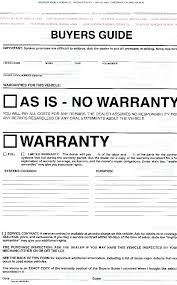
The regulation requires dealerships to affix the Federal Trade Commission’s Buyer’s Guide (a/k/a “window sticker”) to any used vehicle offered for sale. It specifically requires that before a used vehicle is offered for sale, a seller must prepare, fill in as applicable, and display on the vehicle a “Buyer’s Guide.” 16 C.F.R. §455.2(a). “The Buyers Guide shall be displayed prominently and conspicuously in any location on a vehicle and in such a fashion that both sides are readily readable.” 16 C.F.R. § 455.2(a)(1).

A cause of action for violation of the regulation exists under the Magnuson– Moss Warranty Federal Trade Commission Improvement Act (“MMWA”), 15 U.S.C. §2301 et seq. The MMWA is designed to “improve the adequacy of information available to consumers, prevent deception, and improve competition in the marketing of consumer products.” 15 U.S.C. § 2302(a). Under15 U.S.C. § 2310(d) (1), a consumer is entitled to recover when s/he is “damaged by the failure of the supplier to comply with any obligation under this title.” See e.g., Tague v. Autobarn Motors, Ltd., 394 Ill. App. 3d 268, 279, 914 N.E.2d 710, 718 (Ill. App. Ct. 2009) (rejecting claim that dealership did not properly display or provide him Buyers Guide); Schultz v. Burton-Moore Ford, Inc., 2008 WL 5111897 (E.D. Mich. Dec. 2, 2008) (factual dispute existed as to whether dealership violated 16 C.F.R. § 455.2(2)(b), and thus MMWA, by not completing widow sticker).

Some states incorporate the Federal Used Car Buyer’s Guide Regulation by reference in their state laws (which, among other things, authorizes state and local law enforcement officials to ensure that dealers post Buyers Guides and to fine them if they do not comply). See, e.g., California Vehicle Code §11713.1(t) (“it is a violation of this code for the holder of a dealer’s license issued under this article . . . [d]isplay or offer for sale a used vehicle unless there is affixed to the vehicle the Federal Trade Commission’s Buyer’s Guide as required by Part 455 of Title 16 of the Code of Federal Regulations”); California Vehicle Code §11614 (“[n]o lessor- retailer licensed under this chapter may do any of the following in connection with any activity for which this license is required: (v) To display or offer for sale any used vehicle unless there is affixed to the vehicle the Federal Trade Commission’s Buyer’s Guide as required by Part 455 of Title 16 of the Code of Federal Regulations”).

Perhaps auto dealer insurers who utilize the ISO-based Auto Dealer Coverage Form will offer a manuscript endorsement to cover this risk.

Posted in ADCF Policy, Auto Dealer, Coverage | Tagged , , , | 1 Comment

The Graves Amendment: Is an Auto Dealer Vicariously Liable for a Customer’s Negligent Operation of a Loaner Vehicle?


untitled (12)By Greg Johnson. Does the Graves Amendment apply to auto dealerships who provide loaner vehicles to their customers? In a previous post, I provided an overview of the Transportation Equity Act of 2005 (49 USC § 30106) (a/k/a “Graves Amendment”), a federal law which preempts state law imposing liability on vehicle owners engaged in the business of renting or leasing motor vehicles absent negligence on the part of the vehicle owner. (See “Leasing, Renting & Vicarious Liability: An Overview of the Graves Amendment”). Whether a dealership qualifies for protection under the Graves Amendment when sued for a customer’s negligent operation of a loaner vehicle is a significant issue to many parties. It is obviously significant to the dealership’s liability insurer, the customer’s personal auto liability insurer and the customer. It is also important to the injured party and, depending on the severity of the injuries, the injured party’s underinsured motorist carrier.

Over the past twenty five years, I’ve represented many auto dealers and garage liability insurers. Back when the Graves Amendment was passed in 2005, I was of the view that the statute would not apply to most dealers in most loaner vehicle situations – i.e., where there was no rental agreement or charge assessed to the customer for the use of the vehicle. My reasoning was essentially two-fold. First, auto dealerships are not usually “engaged in the trade or business of renting or leasing motor vehicles,” as required by 49 U.S.C. § 30106(a)(1) of the Graves Amendment. Most auto dealers do not rent vehicles to the public. (To the extent a dealer does, it needs to insure the activity under a Business Auto Policy rather than the Auto Dealer Coverage Form as the latter contains an exclusion for public rentals).

The Graves Amendment does not define the trade or business of “renting or leasing motor vehicles,” or its constituent terms “renting” and “leasing.” However, the consistent and established understanding of the term “leasing” is the transfer of the right to possession and use of goods for a term in return for consideration. See UCC 2–A–103(j). The central distinguishing characteristic of a lease is the surrender of absolute possession and control of property to another party for an agreed-upon rent. See Black’s Law Dictionary (8th Ed. 2004) (“[t]o grant the possession and use of (land, buildings, rooms, movable property, etc.) to another in return for rent or other consideration”). The term “rent,” when used as a noun, means the “[c]onsideration paid, usu. periodically, for the use and occupancy of property (esp. real property).” Black’s Law Dictionary (8th Ed. 2004). When used as verbs, the words “lease” and “rent” are generally synonymous. See e.g., Zizersky v. Life Quality Motor Sales, Inc., 21 Misc.3d 871, 878, 866 N.Y.S.2d 501 (Sup. Ct., Kings County 2008).

Second, the legislative history of the Graves Amendment, although sparse, didn’t support extending its scope to the typical loaner vehicle situation. One of the reasons cited in support of adoption of the Graves Amendment was the adverse impact vicarious liability laws had been having on rental rates, which are not applicable in the case of the typical “free” loaner vehicle. See, Statement of Rep. Graves, 151 Cong. Rec. H1200 (daily ed. March 9, 2005) (“Since companies cannot prevent their vehicles from being driven to a vicarious liability state, they cannot prevent their exposure to these laws and must raise their rates accordingly. These higher costs have driven many small companies out of business, reducing the consumer choice and competition that keeps costs down.”); H. Rpt. 106-774, pt. 1, at 4 (“because rented or leased motor vehicles are frequently driven across state lines, these small number of vicarious liability laws impose a disproportionate and undue burden on interstate commerce by increasing rental rates for all customers across the Nation.”).

Applying the common definitions of “renting” and “leasing,” the vehicle owner must be “engaged in the trade or business” of transferring the right to possession of vehicles in exchange for consideration, an agreed-upon rent, for the Graves Amendment to apply.

There has been case law addressing the “loaner” vehicle issue since the passage of the Graves Amendment. In Zizersky v. Life Quality Motor Sales, Inc., 21 Misc.3d 871, 866 N.Y.S.2d 501 (Sup. Ct., Kings County 2008), the court held the Graves Amendment did not apply because the dealership supplied a “loaner” vehicle to the lessee without charge while the lessee’s car was being serviced, and thus the loaner vehicle could not be deemed to have been “rented” or “leased.” In Zizersky, the plaintiff was driving her car when a BMW vehicle operated by a customer of the defendant dealership negligently collided with her vehicle. The BMW was owned by the dealership, and given to a customer for use while the customer’s vehicle was being serviced by the dealership. The dealership sought dismissal based upon the Graves Amendment. The court denied the dealership’s motion. It rejected the argument that the right to repair the vehicle rendered the loaner vehicle “rented” or “leased” for purposes of the Graves Amendment, and found that the loan of the vehicle was a “simple bailment.” 866 N.Y.S.2d at 501. In making this determination, the court found that “the central distinguishing characteristics of a lease is the surrender of absolute possession and control of property for the agreed-upon rent.” Id. Further, under the circumstances presented, the court held that interpreting the statute to include “loaner” vehicles as “rented” or “leased” would not aid the purposes of the Graves Amendment namely “reduction of insurance costs that will in turn result in a reduction of consumer prices and allow more lessors to remain in business.” Id. As such, the court found that the statute did not act to protect the dealership from the plaintiff’s vicarious liability claim. It also noted that the dealership’s interpretation of the Graves Amendment would undermine the policy of the State’s Vehicle and Traffic Law and suggested it needed a “clearer indication from Congress” before interpreting the statute more broadly. Id.

In Murphy v. Pontillo, 12 Misc.3d 1146, 820 N.Y.S.2d 743 (Sup. Ct., Nassau County 2006), the court found insufficient evidence to determine as a matter of law that a car dealership was “a business in the business of vehicle leasing or renting, or that the defendant … leased or rented the van involved in the accident” because the agreement between the customer and dealership was entitled “Renter/Loaner Agreement” and there was no proof that the renter had ever paid for the use of the vehicle.

Assuming the Graves Amendment does not protect the dealer – at least in the typical loaner vehicle context, the dealership would be exposed to vicarious liability if the accident occurred in a jurisdiction, like Minnesota, which imposes vicarious liability upon the owner of a motor vehicle when it is permissively operated by another. See, Minn. Stat. § 169.09, subd. 5a (previously Minn. Stat. § 170.54) (“[w]henever any motor vehicle shall be operated within this state, by any person other than the owner, with the consent of the owner, express or implied, the operator thereof shall in case of accident, be deemed the agent of the owner of such motor vehicle in the operation thereof”).

However, the dealership’s vicarious liability may not be unlimited. At the time the Graves Amendment was passed in 2005, only three states allowed unlimited liability. The other states had enacted legislation which limited or capped vicarious liability. For example, the Minnesota legislature enacted a statutory cap on vicarious liability which limited a rental-vehicle owner’s vicarious liability to certain designated amounts. Upon passage in 1995, Minn. Stat. § 65B.49, subd. 5(a)(i)(2) provided:

Notwithstanding section 169.09, subdivision 5a, an owner of a rented motor vehicle is not vicariously liable for legal damages resulting from the operation of the rented motor vehicle in an amount greater than $100,000 because of bodily injury to one person in any one accident and, subject to the limit for one person, $300,000 because of injury to two or more persons in any one accident, and $50,000 because of injury to or destruction of property of others in any one accident, if the owner of the rented motor vehicle has in effect, at the time of the accident, a policy of insurance or self-insurance, as provided in section 65B.48, subdivision 3, covering losses up to at least the amounts set forth in this paragraph. * * * Nothing in this paragraph alters or affects liability, other than vicarious liability, of an owner of a rented motor vehicle.

At first glance, the Minnesota cap statute appears to only apply to vehicle owners who rent vehicles to the public. However, a vehicle is considered “rented” under the statute if (1) the rate for the use of the vehicle is determined on a monthly, weekly, or daily basis; or (2) during the time that a vehicle is loaned as a replacement for a vehicle being serviced or repaired regardless of whether the customer is charged a fee for the use of the vehicle. Minn. Stat. § 65B.49, subd. 5a(i)(1). Thus, the typical loaner vehicle is considered a “rented” vehicle. (In Schmakel v. Kline-Oldsmobile-Mitsubishi, Ramsey Cty. Dist. Ct. File. No.: C5-98-8982 (May 17, 1999), a case my office handled (and which arose several years prior to the passage of the Graves Amendment in 2005), the Ramsey County District Court in St. Paul, Minnesota rejected the Schmakel’s claim that the statutory cap on vicarious liability was unconstitutional).

The Graves Amendment likely does not apply in the typical loaner vehicle situation such that a dealer will be vicariously liable in states with owner liability statutes when its customer causes injury or damages to third parties. In those jurisdictions, it will be important to consult applicable statutes imposing caps liability as well as statutes (and case law) addressing the insuring obligations of the dealership’s liability insurer and the customer’s personal auto insurer relative to priority of payment.

This blog is for informational purposes only. By reading it, no attorney-client relationship is formed. The law is constantly changing and if you want legal advice, please consult an attorney.  Gregory J. Johnson. © All rights reserved. 2014.

Posted in ADCF Policy, Auto Dealer, BAP, Coverage, Duty to Indemnify, PAP, Rentals | Tagged , , | Leave a comment

Odd Federal Graves Amendment Case: to Avoid Vicarious Liability Owner of Vehicle Must Prove its Affiliate was also Free of Negligence.


By Greg Johnson. In Stratton v. Wallace, 11-CV-74-A HKS, 2014 WL 3809479 (W.D.N.Y. Aug. 1, 2014), the court came to an odd result under the Graves Amendment (Transportation Equity Act of 2005 (49 USC § 30106)), a statute intended to preempt state law imposing liability on vehicle owners engaged in the business of renting or leasing motor vehicles absent a showing of negligence or criminal wrongdoing on the part of the owner. I recently posted an overview of the law entitled “Leasing, Renting & Vicarious Liability: An Overview of the Graves Amendment.”

In Stratton v. Wallace, the court interpreted the Graves Amendment to require that both the vehicle owner/lessor and its affiliate/lessee must be free of negligence in order for the statute to apply. This ruling is likely wrong.

The preemption clause of the Graves Amendment provides, in part, as follows:

(a) In general.-An owner of a motor vehicle that rents or leases the vehicle to a person (or an affiliate of the owner) shall not be liable under the law of any State or political subdivision thereof, by reason of being the owner of the vehicle (or an affiliate of the owner), for harm to persons or property that results or arises out of the use, operation, or possession of the vehicle during the period of the rental or lease, if-

(1) the owner (or an affiliate of the owner) is engaged in the trade or business of renting or leasing motor vehicles; and

(2) there is no negligence or criminal wrongdoing on the part of the owner (or an affiliate of the owner).

In the typical Graves Amendment case — where the vehicle’s owner and operator are related only by an arm’s length contract – the outcome is generally simple. Under the Graves Amendment, the owner is not liable to the injured claimant so long as (1) the owner’s business is leasing or renting vehicles; and (2) the owner was not negligent.

However, the Graves Amendment becomes more difficult to apply where the owner/lessor and the lessee are related by more than just a lease agreement; such as where the owner/lessor and the lessee are owned by the same parent company. The Graves Amendment contemplates this situation by providing that the statute may also apply to a vehicle owner’s “affiliate.” (49 U.S.C. § 30106(d) (1)).

One issue is whether the statute will apply to insulate the vehicle owner from liability when its affiliate is allegedly liable or whether both the owner and affiliate must be free of negligence.

This issue was recently addressed in Stratton v. Wallace, a decision released on August 1, 2014. In that case, Julie Stratton’s car hit a deer while she was driving on an interstate in New York. While she was sitting in her disabled vehicle on the side of the road, Thomas Wallace, who was driving a tractor-trailer owned by Great River Leasing, struck Ms. Stratton’s car and killed her.

Great River had leased the tractor-trailer to Wallace’s employer, Millis Transfer, Inc. (Millis). Midwest Holding Group, Inc. (Midwest) was the parent company of Great River and Mathis.

Stratton’s estate brought an action against Great River, the vehicle owner, Millis, Wallace’s employer, Wallace and Midwest. Under New York’s vicarious liability statute “[e]very owner of a vehicle” is liable for injuries caused by the use of the vehicle “by every person using or operating the same with the permission, express or implied, of such owner.” (N.Y. Vehicle & Traffic Law § 388). Thus, if the driver to whom the vehicle is entrusted was negligent, the owner is vicariously liable regardless of whether the owner was negligent.

Great River moved for summary judgment on the basis it was insulated from vicarious liability by the Graves Amendment, 49 U.S.C. § 30106. Great River and Millis were clearly “affiliates” under the statute. The issue was whether the Graves Amendment would apply to insulate Great River, the vehicle owner, from vicarious liability under the New York owner’s statute when its affiliate, Millis, was allegedly liable.

The estate argued the Graves Amendment did not apply to shield Great River from liability because: (1) the estate claimed Millis was negligent; (2) Millis was an “affiliate” of Great River within the definition of the Graves Amendment; (3) that, therefore, subsection (a) (2) of the Graves Amendment was not satisfied; and (4) accordingly, the Graves Amendment did not shield Great River from vicarious liability. Making the appropriate substitutions urged by the estate, the Graves Amendment would provide as follows: “[Great River] shall not be liable under the law of any State … by reason of being the owner of the vehicle … for harm to persons or property that results or arises out of the use, operation, or possession of the vehicle during the period of the rental or lease, if- (1) [Great River or Millis] is engaged in the trade or business of renting or leasing motor vehicles; and (2) there is no negligence or criminal wrongdoing on the part of [Great River or Millis].” Great River, on the other hand, argues that because it was the owner of the truck at issue-and thus, the party seeking to benefit from the Graves Amendment’s protection — subsections (a) (1) and (a)(2) of the Graves Amendment should be read to include only Great River, and not Great River’s affiliate, Millis. Because Great River was not alleged to have any negligence, it would be dismissed from the suit under this reading.

The Magistrate Judge recommended granting Great River’s motion for summary judgment. The Magistrate noted the Graves Amendment “was plainly intended to eliminate vicarious liability for owners engaged in the business of renting or leasing motor vehicles who are free from negligence and, likewise, affiliates of owners who are engaged in the business of renting or leasing motor vehicles and are likewise free from negligence.”

However, the district court concluded otherwise, holding that “both the lessee and lessor [must] be free of negligence” in order for the Graves Amendment to shield a vehicle’s owner from vicarious liability. This interpretation, while plausible, is likely wrong.

The Graves Amendment was intended to extinguish liability for owners engaged in the business of renting or leasing motor vehicles who are free from negligence and affiliates of owners who are engaged in the business of renting or leasing motor vehicles and are likewise free from negligence.” While generally, a non-owner of a vehicle does not need the protection of the Graves Amendment because it ordinarily cannot have vicarious liability under owner statutes, liability claims were presented against non-owner affiliates engaged in the business of renting vehicles on the basis that the affiliate was the alter ego of the vehicle owner and/or should otherwise be treated as if they were the vehicle “owner” for purposes of the statute as they were often in exclusive possession and control of the vehicle under lease agreements with the owner.

When applying the statute, one should do so from the point of view of the party seeking its protection. It is much like interpreting the term “insured” under a commercial liability policy. One has to read the statute (policy) separately from the perspective of the company (insured) seeking its protection. Thus, if the vicarious liability claim is presented against the vehicle owner, the Graves Amendment should be read as follows:

(a) In general. An owner of a motor vehicle that rents or leases the vehicle to a person … or an affiliate … shall not be liable under the law of any State or political subdivision thereof, by reason of being the owner of the vehicle … for harm to persons or property that results or arises out of the use, operation, or possession of the vehicle during the period of the rental or lease, if-

(1) the owner … is engaged in the trade or business of renting or leasing motor vehicles; and

(2) there is no negligence or criminal wrongdoing on the part of the owner …

If the vicarious liability claim is presented against an affiliate of the vehicle owner, the statute should be read as follows:

(a) In general … [A]n affiliate of the owner … shall not be liable under the law of any State or political subdivision thereof, by reason of being … an affiliate of the owner … for harm to persons or property that results or arises out of the use, operation, or possession of the vehicle during the period of the rental or lease, if-

(1) the … affiliate of the owner … is engaged in the trade or business of renting or leasing motor vehicles; and

(2) there is no negligence or criminal wrongdoing on the part of the … affiliate of the owner).

As noted, the district court in Stratton interpreted the statute in a contrary fashion, requiring that both the vehicle owner and the owner’s affiliate be free of negligence. In the district court’s view, if one read the phrase “(or an affiliate of the owner)” as a substitute for the word “owner,” the statute “would then accomplish nothing, because vicarious liability statutes hold owners liable solely because they are owners-not because they are affiliates.” Because the court was unwilling to read the phrase “(or an affiliate of the owner)” as a substitute for the word “owner,” it was compelled to read the balance of the statute in a similar fashion, such that 49 U.S.C. § 30106 (a) (2) required both the owner and affiliate to be free of negligence.

However, as noted above, when the Graves Amendment was passed affiliates needed protection from liability as well because they were often joined in lawsuits involving the vehicle owner on the basis of their exclusive possession and control of the vehicle under lease agreements with the owner.

The Graves Amendment should be interpreted from the perspective of the party seeking its protection. If that party was “engaged in the trade or business of renting or leasing motor vehicles” and was free of negligence, the statute should apply. Hopefully, the Stratton case will be appealed and the appellate court will bring more clarity to the issue.

This blog is for informational purposes only. By reading it, no attorney-client relationship is formed. The law is constantly changing and if you want legal advice, please consult an attorney licensed in your jurisdiction. © All rights reserved. 2010.

Posted in BAP, PAP, Rentals | Tagged , , | 2 Comments

Leasing, Rentals and Vicarious Liability: An Overview of the Graves Amendment


images (7)By Greg Johnson. Over the past twenty five years, I’ve represented many companies engaged in the business of leasing or renting vehicles.  In the 1990’s, prior to the passage of the Transportation Equity Act (49 USC § 30106) (a/k/a “Graves Amendment”) in 2005, a major focus in the leasing and rental industry was on developing contract language that would shift primary liability from rental car companies and auto dealerships to the customer’s personal auto policy when the customer caused injuries or damages as a result of his operation of the leased/rented vehicle. That was particularly so in states such as Minnesota which imposed unlimited vicarious liability on the vehicle owner for the customer’s negligent operation of the vehicle despite the absence of any fault on the vehicle owner. Since vicarious liability was here to stay in the dozen or so states imposing vicarious liability – or so we thought – I drafted rental car contracts for rental car companies and auto dealerships, temporary loaner agreements, policy endorsements and self-insured certificates which would at least shift primary responsibility for damages caused by the customer to the customer’s personal auto carrier. This would eliminate the rental company/dealership exposure in the vast majority of claims as most claims would be paid from the limits of the customer’s policy. The rental car company/auto dealership and their liability insurance (or self-insurance) would only be involved if the damages exceeded the coverage available under the customer’s policy.

Over the next decade, the leasing and rental industry began to chip away at vicarious liability for businesses engaged in leasing or renting vehicles on a short-term basis. In a few of the dozen states imposing vicarious liability on vehicle owners, legislation was passed which eliminated unlimited vicarious liability in favor of statutory caps on that liability. Minnesota, for example, adopted a cap statute which limited liability to $100,000 /$300,000/$50,000. The statutes generally provide that notwithstanding the vicarious liability statute, the owner of a rented vehicle will not be vicariously liable for damages in an amount greater than those described in the cap.

Then, in 2005, Congress passed the Graves Amendment, a federal statute that, in general terms, provides that companies that lease or rent vehicles may not be held vicariously liable for the negligence of those to whom their vehicles are leased or rented.

This post contains a general overview of the Graves Amendment. Subsequent posts will address more unique issues such as whether the Amendment preempts vicarious liability against affiliates, owners of loaner vehicles, taxicabs, car sharing membership companies as well as the impact of the Amendment on self-insurance and drop-down liability limit arrangements.

The Perceived Need for Legislation

In 2005, twelve jurisdictions imposed vicarious liability on the owner of motor vehicle: California, Connecticut, Florida, Idaho, Iowa, Maine, Michigan, Minnesota, Nevada, New York, Rhode Island and the District of Columbia). Under a vicarious liability law, the vehicle owner becomes legally liable for injuries and damages caused by a permissive driver of the motor vehicle. “[V]icarious liability is the ‘imposition of liability on one person for the actionable conduct of another, based solely on a relationship between the two persons.’” Sutherland v. Barton, 570 N.W.2d 1, 5 (Minn.1997) (quoting Black’s Law Dictionary 1566 (6th ed.1990)). Vicarious liability differs from direct negligence claims, such as negligent maintenance or negligent entrustment of a vehicle, which impose liability on the vehicle owner for its active fault. The Minnesota vicarious liability law is found in Minn. Stat. § 169.09, subd. 5a (previously Minn. Stat. § 170.54), which states as follows:

Whenever any motor vehicle shall be operated within this state, by any person other than the owner, with the consent of the owner, express or implied, the operator thereof shall in case of accident, be deemed the agent of the owner of such motor vehicle in the operation thereof.

The Minnesota vicarious liability statute only applies to the “owner” (Minn. Stat. § 65B.43, subd. 4) of a “motor vehicle” (Minn. Stat. §169.011, subd. 42) which is involved in an accident in Minnesota. Boatwright v. Budak, 625 N.W.2d 483, 488 (Minn. Ct. App. 2001). (“[e]mploying a plain-meaning approach,” court held statute only applies “to accidents that occur within Minnesota”); Avis Rent-A-Car System v. Vang, 123 F.Supp.2d 504 (D. Minn. 2000) (Minnesota statute creating liability on part of owner for damages resulting from operation of automobile by another with owner’s consent did not apply to automobile accident in Michigan); West Bend Mut. Ins. Co. v. American Family Mut. Ins. Co., 586 N.W.2d 584 (Minn. Ct. App. 1998) (garage liability policy insuring Minnesota dealership’s vehicles did not afford any liability coverage for accident occurring involving dealership vehicle in Louisiana, a jurisdiction which did not impose vicarious liability); Vee v. Ibrahim, 769 N.W.2d 770, 771-775 (Minn. Ct. App. 2009) (what is a motor vehicle for purposes of vicarious liability statute). The statute is to be interpreted “liberally” to achieve its purpose. Christensen v. Milbank Ins. Co., 643 N.W.2d 639, 642-645 (Minn. Ct. App. 2002). The statute imposes liability on the owner where it would not otherwise exist, thereby giving an injured person more certainty of recovery by encouraging vehicle owners to obtain appropriate liability insurance coverage. Boatwright, 625 N.W.2d at 486.

It is important to note that statutory vicarious liability can only be imposed on the “owner” of a motor vehicle. The definition of “owner” varies from state to state.  In some states, a lessor ceases to be the “owner” in a “long-term” lease situation. In Minnesota, for example, the lessee under a lease of six months or more (a/k/a “long-term” lease) is deemed the “owner” of the vehicle for purposes of the owner liability statute. See Minn. Stat. § 65B.43, subd. 4 (“[i]f a motor vehicle is the subject of a lease having an initial term of six months or longer, the lessee shall be deemed the owner for the purposes of sections 65B.41 to 65B.71, and 169.09, subdivision 5a, notwithstanding the fact that the lessor retains title to the vehicle”). If the lease is for less than six months (a/k/a “short-term” lease), the vehicle owner continues to be the owner and, thus, remains subject to vicarious liability under the vehicle owner liability statute.

Prior to the passage of the Graves Amendment in 2005, some of the twelve jurisdictions which imposed vicarious liability on vehicle owners enacted legislation to temper the result, at least with respect to companies engaged in the business of renting or leasing vehicles. In 1995, the Minnesota legislature enacted Minn. Stat. § 65B.49, subd. 5a(i) which capped vicarious liability with respect to “rented” vehicles. The statute provided in part: “[an] owner of a rented motor vehicle is not vicariously liable for legal damages resulting from the operation of the rented motor vehicle in an amount greater than $100,000 because of bodily injury to one person in any one accident and, subject to the limit for one person, $300,000 because of injury to two or more persons . . . if the owner of the rented motor vehicle has in effect, at the time of the accident, a policy of insurance or self-insurance . . . covering losses up to at least the amounts set forth in this paragraph.” Minn. Stat. § 65B.49, subd. 5a (i) (2).

History of the Graves Amendment

In 2005, Congress, in response to the effect of vicarious liability statutes on the leasing and rental car industry, inserted what is colloquially referred to as the Graves Amendment into the Transportation Equity Act of 2005 (49 USC § 30106). The legislation was initially sought by car dealer groups, who wanted to “eliminate vicarious liability.” Susan Lorde Martin, Commerce Clause Jurisprudence and the Graves Amendment: Implications for the Vicarious Liability of Car Leasing Companies, 18 U. FLA. J.L. & PUB. POL’Y 153, 154 (Aug.2007). The car lobbyists had been unsuccessful in repealing a New York state law imposing vicarious liability. The legislative history of the Graves Amendment is quite sparse. There were no committee hearings or reports to give meaning to the Graves Amendment. The entire substance of the Amendment’s legislative history is contained in three pages of floor debate in the Congressional Record immediately before the House voted on the Amendment. See generally 151 Cong. Rec. H1199–H1205 (daily ed. Mar. 9, 2005) (entirety of House debate and voting history); id. at H1201 (statement of Rep. Conyers) (“It is also important to note that the issue of preempting state liability is under the jurisdiction of the Committee on the Judiciary, of which I am the Ranking Member, and no hearings have been held to examine the appropriateness of the language which would be included in the legislation should the amendment pass. It is irresponsible to allow this provision to be debated on the House floor without a committee of jurisdiction’s careful review.”). See also, Luperon v. N. Jersey Truck Ctr., Inc., 2009 WL 1726340, at *5 n. 4 (S.D.N.Y. June 19, 2009) (noting that “[t]here were no hearings on the Amendment, and the only debate in the House of Representatives was all of twenty minutes long, immediately preceding the vote on the Amendment”).

The history of the Amendment suggests that its intent was to protect rental and leasing companies from vicarious liability when their renters or lessees were involved in accidents. The Graves Amendment was an attempt to bring all states in line with the majority of states that did not impose vicarious liability on vehicle owners. In light of the inherently interstate nature of the vehicle renting and leasing business, Congress was of the view that a uniform, national standard was needed. The opening statement of the Amendment’s sponsor, Representative Graves, supports this conclusion. According to Representative Graves, “currently, a small number of States impose vicarious liability or limitless liability without fault, on companies and their affiliates simply because they own a vehicle involved in an accident. Whether or not the vehicle was at fault is completely irrelevant in these situations. These vicarious liability lawsuits cost consumers nationwide over $100 million annually. Vicarious liability laws apply where the accident occurs. It does not matter where the car or truck was rented or leased. Since companies cannot prevent their vehicles from being driven to a vicarious liability State, they cannot prevent their exposure to these laws and must raise their rates accordingly. These higher costs have driven many small companies out of business, reducing the consumer choice and competition that keeps costs down.” 151 Cong. Rec. H1200 (daily ed. Mar. 9, 2005) (statement of Rep. Graves). The Amendment’s co-sponsor made similar arguments, stating: “vicarious liability laws for rental cars in a handful of States drive up costs for consumers nationwide by an average of $100 million annually. These laws allow unlimited damages against companies that rent vehicles solely because the company owns the vehicle that is involved in the accident, not because the company has done anything wrong. These companies are not negligent, they are not at fault, they could have done nothing to have prevented the accident.”151 Cong. Rec. H1200 (daily ed. Mar. 9, 2005) (statement of Rep. Boucher).

These statements indicate the Graves Amendment was concerned with the problem of (1) imposing liability based solely on ownership status, when (2) the commercial rental and leasing companies had no choice as to whom they rent their vehicles or into what state those vehicles were driven. As a result, rental and leasing companies found themselves vicariously liable for their renter’s or lessee’s negligence depending on whether the renter or lessee drove into one of the twelve jurisdictions that imposed vicarious liability on vehicle owners. See, Statement of Rep. Graves, 151 Cong. Rec. H1200 (daily ed. March 9, 2005) (“Since companies cannot prevent their vehicles from being driven to a vicarious liability state, they cannot prevent their exposure to these laws and must raise their rates accordingly. These higher costs have driven many small companies out of business, reducing the consumer choice and competition that keeps costs down.”); H. Rpt. 106-774, pt. 1, at 4 (“because rented or leased motor vehicles are frequently driven across state lines, these small number of vicarious liability laws impose a disproportionate and undue burden on interstate commerce by increasing rental rates for all customers across the Nation”).

Ultimately, the Amendment was enacted to protect the vehicle rental and leasing industry against claims for vicarious liability where the leasing or rental company’s only relation to the claim was that it was the technical owner of the car. See, Statement of Rep. Graves, 151 Cong. Rec. H1200, 1034 (daily ed. March 9, 2005).

The Graves Amendment is applicable to all actions “commenced on or after August 10, 2005 without regard to whether the harm that is the subject of the action, or the conduct that caused the harm, occurred before such date of enactment.” 49 U.S.C. § 30106(c).

The Preemption Clause

The preemption clause of the Graves Amendment provides as follows:

(a) In general.-An owner of a motor vehicle that rents or leases the vehicle to a person (or an affiliate of the owner) shall not be liable under the law of any State or political subdivision thereof, by reason of being the owner of the vehicle (or an affiliate of the owner), for harm to persons or property that results or arises out of the use, operation, or possession of the vehicle during the period of the rental or lease, if-

(1) the owner (or an affiliate of the owner) is engaged in the trade or business of renting or leasing motor vehicles; and

(2) there is no negligence or criminal wrongdoing on the part of the owner (or an affiliate of the owner).

Given the clear language and purpose of the Amendment, numerous courts have found the Graves Amendment preempts state law imposing liability on vehicle owners engaged in the business of renting or leasing motor vehicles (absent a showing of negligence or criminal wrongdoing on the part of the owner) and is constitutional. See, e.g.,Windmill Distrib. Co. L.P. v. Hartford Fire Ins. Co., 449 F. App’x 81, 82 (2d Cir.2012); Carton v. Gen. Motor Acceptance Corp., 611 F.3d 451 (8th Cir.2010); Cates v. Hertz Corp., 347 F. App’x 2 (5th Cir.2009); Garcia v. Vanguard Car Rental USA, Inc., 540 F.3d 1242 (11th Cir.2008), cert. denied, 129 S. Ct. 1369, 173 L.Ed.2d 591 (2009); Rodriguez v. Testa, 296 Conn. 1, 993 A.2d 955 (Conn. 2010) (“we join the overwhelming majority of federal courts that have considered the question and concluded that the Amendment is constitutional”); Watson v. Majewski, 2011 WL 4944430 (E.D. Mich. Oct.18, 2011); Johnson v. XTRA Lease LLC, 2010 WL 706037 (N.D. Ill. 2010); Martin v. Crook, 2009 WL 2392077 (Iowa Ct. App. Aug. 6, 2009); Hagen v. U–Haul Co. of Tenn., 613 F.Supp.2d 986 (W.D.Tenn.2009); Kersey v. Hirano, 2009 WL 2151845 (D. Md. July 15, 2009); Green v. Toyota Motor Credit Corp, 605 F. Supp.2d 430 (E.D.N.Y.2009); Rein v. CAB East LLC, 2009 WL 1748905 (S.D.N.Y. June 22, 2009); Pacho v. Enterprise Rent–A–Car Co., 572 F.Supp.2d 341, 350 (S.D.N.Y.2008); Berkan v. Penske Truck Leasing Canada, Inc., 535 F.Supp.2d 341 (W.D.N.Y.2008); Jasman v. DTG Operations, Inc., 533 F.Supp.2d 753 (W.D. Mich. 2008); Stampolis v. Provident Auto Leasing Co., 586 F. Supp.2d 88 (E.D.N.Y.2008); Flagler v. Budget Rent A Car System, Inc., 538 F. Supp.2d 557 (E.D.N.Y.2008); Berkan v. Penske Truck Leasing Canada, Inc., 535 F. Supp.2d 341 (W.D.N.Y.2008); Jasman v. DTG Operations, Inc., 533 F. Supp.2d 753 (W.D.Mich.2008); Dolter v. Keene’s Transfer, Inc., 2008 WL 3010062 (S.D. Ill. Aug.2, 2008); West v. Enterprise Leasing Co., 997 So.2d 1196 (Fla. Ct. App. 2 Dist. 2008); Vargas v. Enter. Leasing Co., 993 So.2d 614 (Fla. 4th DCA 2008); Lucas v. Williams, 984 So.2d 580 (Fla. 1st DCA 2008); Kumarsingh v. PV Holding Corp., 983 So.2d 599 (Fla. 3d DCA), review denied, 984 So.2d 519 (Fla.2008) (table); Bechina v. Enterprise Leasing Co., 972 So.2d 925 (Fla. 3d DCA 2007); Dupuis v. Vanguard Car Rental USA, Inc., 510 F. Supp.2d 980 (M.D.Fla.2007); Seymour v. Penske Truck Leasing Co., L.P., 2007 WL 2212609 (S.D. Ga. July 30, 2007); Jones v. Bill, 34 A.D.3d 741, 825 N.Y.S.2d 508 (N.Y.A.D. 2 Dept. 2006). Contra Vanguard Car Rental USA, Inc. v. Huchon, 532 F. Sup.2d 1371 (S.D.Fla.2007) (holding Graves Amendment unconstitutional); Vanguard Car Rental USA, Inc. v. Drouin, 521 F. Sup.2d 1343 (S.D.Fla.2007) (finding amendment unconstitutional).

Courts determining the constitutionality of the Graves Amendment generally concluded that Congress may regulate under its commerce power because car rental companies are “instrumentalities of, and things in, interstate commerce” and should not be subjected to state by state regulatory regimes that can dramatically burden their operations even if only on an intrastate basis.  They also have concluded that “vicarious liability laws may, in the aggregate, adversely affect the motor vehicle leasing market.” Green v. Toyota Motor Credit Corp, 605 F. Supp. 430 at 435. This is because leasing companies could cease doing business in states with vicarious liability laws or increase the cost of leasing cars to consumers in those and other states. Green, at 435–36.

In 2010, in Meyer v. Nwokedi, 777 N.W.2d 218 (Minn. 2010), the Minnesota Supreme Court followed the lead of the vast majority of jurisdictions in holding the Graves Amendment preempted state vicarious liability laws which imposed liability on the owner of rented and leased motor vehicles such as Minn. Stat. § 169.09.

Trade or Business of Renting or Leasing

The statute does not define the trade or business of “renting or leasing motor vehicles,” or its constituent terms “renting” and “leasing.” However, the consistent and established understanding of the term “leasing” is the transfer of the right to possession and use of goods for a term in return for consideration. See UCC 2–A–103(j). The central distinguishing characteristic of a lease is the surrender of absolute possession and control of property to another party for an agreed-upon rent. See Black’s Law Dictionary (8th Ed. 2004) (“[t]o grant the possession and use of (land, buildings, rooms, movable property, etc.) to another in return for rent or other consideration”). The term “rent,” when used as a noun, means the “[c]onsideration paid, usu. periodically, for the use and occupancy of property (esp. real property).” Black’s Law Dictionary (8th Ed. 2004). When used as verbs, the words “lease” and “rent” are generally synonymous.  See e.g., Zizersky v. Life Quality Motor Sales, Inc., 21 Misc.3d 871, 878, 866 N.Y.S.2d 501 (Sup. Ct., Kings County 2008).

Independent Negligence

It is important to recognize that while the Graves Amendment insulates the leasing or rental company from vicarious liability based on its ownership of the involved vehicle, it does not absolve them from liability for their independent negligence. See 49 U.S.C. § 30106(a) (2) (there must be “no negligence or criminal wrongdoing on the part of the owner . . .”). In the absence of any independent negligence contributing to the accident, the leasing or rental company is not liable to a person injured by the vehicle.

The most frequently asserted negligence claim against leasing and rental companies is negligent maintenance. A claim based upon negligent maintenance is not barred by the Graves Amendment because the statute does not absolve leasing companies of their own negligence. See Collazo v. MTA–New York City Tr., 74 A.D.3d 642, 905 N.Y.S.2d 30 (2010). Courts have expressed concern that plaintiffs can defeat the spirit of Section 30106 on a motion to dismiss by merely alleging that the leasing company was negligent in maintaining the vehicle. A boiler-plate failure to maintain allegation contained in a complaint pertaining to a motor vehicle accident should not be used as a means to avoid Congress’ clear intent in enacting the Graves Amendment to forestall suits against vehicle rental and leasing companies. See e.g., Johnson v. Alamo Fin., L.P., 2009 WL 4015572 at*2 (M.D. Fla. Nov. 19, 2009); Colon v. Bernabe, 2007 WL 2068093 at *5 (S.D. N.Y. July 19, 2007)). Accordingly, it has been held that while the express language of Section 30106(a) (2) creates an exception to the Graves Amendment, “it is rarely applicable and should be cautiously applied in light of Congress; clear intent to forestall suits against vehicle leasing companies.” Carton v. General Motors Acceptance Corp., 639 F.Supp.2d 982, 996 (N.D. Iowa 2009), affirmed 611 F.3d 451 (8th Cir. Iowa 2010) (citing Dubose v. Transport Enterprise Leasing, LLC, 2009 WL 210724, at *14 (M.D. Fla. Jan. 27, 2009).

In Moreau v. Josaphat, 42 Misc. 3d 345, 975 N.Y.S.2d 851 (N.Y. Sup. Ct. 2013), the court held the defendant lessor had made a prima facie showing that they were entitled to summary judgment dismissing plaintiffs’ vicarious liability cause of action where it submitted evidence that no complaint or issues were brought to its attention with regard to maintenance or operation of the vehicle during the time the vehicle was in its possession through the date of the subject accident, it conducted a regularly scheduled maintenance program and regular service and maintenance was performed on the subject vehicle. Moreover, there was no evidence suggesting that a maintenance issue or mechanical failure caused or contributed to the subject accident.

In Vedder v. Cox, 18 Misc.3d 1142[A], 2008 WL 595857 (Sup. Ct., Nassau County 2008), a motion to dismiss based upon the Graves Amendment granted where, among other things, the defendant’s loss control manager stated that she had searched the maintenance records for the subject vehicle, found that no maintenance or repairs had been performed, that there had been no complaints from renters, and that the vehicle had been inspected for damages and performance problems between rentals.

In Dubose v. Transp. Enter. Leasing, LLC, 2009 WL 210724 (M.D. Fla. Jan.27, 2009), the court suggested the Graves Amendment barred claims of “negligent entrustment” against a vehicle owner. The court analyzed several state and federal court decisions interpreting the Graves Amendment and stated as follows:

Absent some evidence of a lessor’s failure to properly maintain a vehicle which it has expressly agreed to maintain pursuant to a lease agreement, or some similar active negligence on the part of the lessor, the conclusion reached by these courts is that § 30106(a) (2) is rarely applicable and should be cautiously applied in light of Congress’ clear intent to forestall suits against vehicle leasing companies. Indeed, unless a State specifically imposes a legal duty on lessors to ensure that their lessees maintain adequate insurance or to ensure that their lessees have adequate driving records, § 30106(a)(2) only appears to apply to claims predicated on criminal wrongdoing and negligent maintenance claims — not claims of negligent entrustment.

The Eighth Circuit Court of Appeals disagreed with the Dubose interpretation. In Carton v. General Motor Acceptance Corp., 611 F.3d 451, 456-458 (8th Cir. 2010), the Eighth Circuit concluded thought that interpretation – which limited the term “negligent’ to claims of “negligent maintenance” and not claims “negligent entrustment” – was too narrow. The court noted that the term “negligence” as used in the Graves Amendment “is a broad term, and nothing indicated that the term “negligence” should be construed narrowly to exclude (i.e., save) only claims for negligent maintenance.

State Insurance Obligations

It is important to recognize the Graves Amendment does not affect insuring obligations which are imposed on the owner of a rented or leased motor vehicle under state law, including any omnibus coverage requirements. The savings provisions in 49 U.S.C. § 30106(b) provide in relevant part:

Nothing in this section supersedes the law of any State …

(1) imposing financial responsibility or insurance standards on the owner of a motor vehicle for the privilege of registering and operating a motor vehicle; or

(2) imposing liability on business entities engaged in the trade or business of renting or leasing motor vehicles for failure to meet the financial responsibility or liability insurance requirements under State law.

“Financial responsibility,” as used in the savings clause, is not defined by 49 U.S.C. § 30106(d) or 49 U.S.C. § 30102 (2006) (both providing definitions for the Graves Amendment). However, in Garcia v. Vanguard Car Rental USA, Inc., 540 F.3d 1242 (11th Cir.2008), cert. denied, 555 U.S. 1174, 129 S. Ct. 1369, 173 L.Ed.2d 591 (2009), the Eleventh Circuit Court of Appeals interpreted the meaning of the phrase “financial responsibility” in the Graves Amendment to determine whether a Florida wrongful death action was preempted. The court concluded that Congress “used the term ‘financial responsibility law[s]’ to denote state laws which impose insurance-like requirements on owners or operators of motor vehicles.” Garcia, 540 F.3d at 1244. Other courts have followed Garcia and likewise concluded that “financial responsibility” laws are laws that impose insurance like requirements on motor vehicle owners. See e.g., Rodriguez v. Testa, 296 Conn. 1, 993 A.2d 955 (2010) (“we agree with the well-reasoned analysis in Garcia and with that court’s conclusion that the ‘financial responsibility or liability insurance requirements’ to which the savings clause refers consist of insurance like requirements imposed on business entities engaged in the trade or business of renting or leasing motor vehicles”); Meyer v. Nwokedi, 777 N.W.2d 218, 224 (Minn. 2010) (“[w]e agree with Garcia and conclude that “financial responsibility” refers to insurance-like requirements under state law”); West v. Enterprise Leasing Co., 997 So.2d 1196, 1197–98 (Fla. Ct. App. 2008) (same).

The court in Garcia outlined the types of state laws not subject to preemption under the Graves Amendment – i.e., those falling within the savings clause.  They include those which require liability insurance or its equivalent as a condition of licensing or registration, or which impose such a requirement after an accident or unpaid judgment. Garcia v. Vanguard Car Rental USA, Inc., 540 F.3d at 1249 (citing 49 U.S.C. § 30106(b)(1) (2006)). States may also suspend the license and registration of, or otherwise penalize, a car owner who fails to meet the requirement, or who fails to pay a judgment resulting from a collision. Garcia, at 1249 (citing 49 U.S.C. § 30106(b)(2) (2006)). However, states may not impose such judgments against rental or leasing companies based on the negligence of their lessees. Garcia, at 1249 (citing 49 U.S.C. § 30106(a) (2006)).

In a few cases, plaintiffs have argued that state law caps on vicarious liability of rental car companies fall within the savings clause such that the Graves Amendment’s preemption of all vicarious liability did not apply. In Garcia, the court interpreted a Florida statute and held that state statutes which allow vehicle owners to avoid unlimited vicarious liability by obtaining higher levels of liability insurance, do not fall within the savings clause because they do not impose an affirmative duty on the vehicle owner to obtain such coverage. Garcia, at 1248 (rejecting the argument that the Graves Amendment distinguishes between limited and unlimited vicarious liability statutes: “[t]he distinction Congress drew is between liability based on the companies’ own negligence and that of their lessees, not between limited and unlimited vicarious liability”). See also, Rodriguez v. Testa, 296 Conn. 1, 993 A.2d 955 (2010) (applying Garcia and holding Conn. Gen. Stat. § 14–154a (b)(1) “does not impose an insurance requirement on the owners of rented or leased vehicles but presents them with an option to choose additional coverage if they seek to avoid vicarious liability”); Rahaman v. Falconer, 2009 WL 1958508, at *6 (Conn.Super.Ct. June 9, 2009) (unpublished opinion) (Connecticut’s vicarious-liability cap statute neither compels liability insurance nor imposes liability for failure to meet “liability insurance requirements”).

In Meyer v. Nwokedi, 777 N.W.2d at 224 (Minn. 2010), the Minnesota Supreme Court followed Garcia and concluded that Minn. Stat. § 65B.49, subd. 5a (i)) did not fall within savings clause because nothing in the statute required rental vehicle owners to maintain the higher levels of liability insurance designated in the statute.

In 1995, one decade before passage of the Graves Amendment, the Minnesota legislature enacted a statute which limited the vicarious liability of the owner of a rental vehicle. Essentially, in exchange for the owner maintaining at least $100,000/$300,000 of bodily injury liability coverage, the owner’s liability would be capped in those amounts. If the owner did not carry coverage with those limits, the owner’s vicarious liability remained unlimited. The vicarious liability cap statute provided:

Notwithstanding section 169.09, subdivision 5a, an owner of a rented motor vehicle is not vicariously liable for legal damages resulting from the operation of the rented motor vehicle in an amount greater than $100,000 because of bodily injury to one person in any one accident and, subject to the limit for one person, $300,000 because of injury to two or more persons in any one accident, and $50,000 because of injury to or destruction of property of others in any one accident, if the owner of the rented motor vehicle has in effect, at the time of the accident, a policy of insurance or self-insurance, as provided in section 65B.48, subdivision 3, covering losses up to at least the amounts set forth in this paragraph. Nothing in this paragraph alters or affects the obligations of an owner of a rented motor vehicle to comply with the requirements of compulsory insurance through a policy of insurance as provided in section 65B.48, subdivision 2, or through self-insurance as provided in section 65B.48, subdivision 3, which policy of insurance or self-insurance must apply whenever the operator is not covered by a plan of reparation security as provided under paragraph (a); or with the obligations arising from section 72A.125 for products that are sold in conjunction with the rental of a motor vehicle. Nothing in this paragraph alters or affects liability, other than vicarious liability, of an owner of a rented motor vehicle.

The plaintiffs in Meyer argued that this statute fell within the savings clause such that the Graves Amendment’s preemption of all vicarious liability did not apply. The Meyer court made short shrift of the plaintiff’s argument. Following the lead of the Eleventh Circuit Court of Appeals in Garcia v. Vanguard Car Rental USA, Inc., 540 F.3d 1242, 1253(11th Cir. 2008), which had construed a similar statutory cap provision under Florida law, the Meyer court determined that Minnesota’s cap statute did not impose “liability . . . for failure to meet insurance like requirements or liability insurance requirements” within the meaning of the Graves Amendment. Meyer, at 225-26. It did not impose any such liability because nothing in the cap statute required the owner to maintain insurance in the amounts of $100,000/$300,000. It was entirely optional. The Meyer court read the cap statute as “allowing insurers to provide extra coverage regardless of any provisions that impose minimum coverage requirements.” Id. at 226. The court summarized its holding as follows:

In summary, we conclude that Minn. Stat. § 65B.49, subd. 5a(i)(2), does not set forth “liability insurance requirements” applicable to rental-vehicle owners and does not impose liability on rental-vehicle owners for failure to meet insurance-like requirements or liability insurance requirements within the meaning of the (b)(2) savings clause. Rather, Minn.Stat. § 65B.49, subd. 5a(i)(2), offers rental-vehicle owners an opportunity to limit their exposure to vicarious liability claims by providing insurance in the amounts of $100,000 per person and $300,000 per accident. Therefore, Meyer’s vicarious liability claim, which is predicated on Minn.Stat. § 65B.49, subd. 5a(i)(2), is preempted by the Graves Amendment.

In the typical Graves Amendment case — where the vehicle’s owner and operator are related only by an arm’s length contract – the outcome is fairly simple. Under the Graves Amendment, the vehicle owner is not liable to the injured claimant so long as (1) the owner’s business is leasing or renting vehicles; and (2) the owner was not negligent.

Subsequent posts will address more unique issues such as whether the Amendment preempts vicarious liability against affiliates, owners of loaner vehicles, taxicabs, car sharing membership companies as well as the impact of the Amendment on self-insurance and drop-down liability limit arrangements.

This blog is for informational purposes only. By reading it, no attorney-client relationship is formed. The law is constantly changing and if you want legal advice, please consult an attorney.  Gregory J. Johnson © All rights reserved. 2014.

← Back

Thank you for your response. ✨

Warning
Warning
Warning

Warning.

Posted in ADCF Policy, Auto Dealer, BAP, Coverage, PAP, Rentals | Tagged , , | 1 Comment

Should an Auto Dealer Insurer Defend an Auto Dealer Against “Intentional” Violations of Credit Sale and Leasing Disclosure Laws?


Introduction

By Greg Johnson. Having worked in the consumer finance and insurance coverage arenas for over twenty years, I have frequently been asked whether an auto dealer’s “intentional” or “wilful” violation of a statutory disclosure law, such as the federal Truth in Lending Act (TILA), Consumer Leasing Act (CLA) or similar state credit sale disclosure law, is covered by the dealer’s policy.  The suit papers, often styled as a class action, often assert the dealer engaged in some type of intentional scheme to deceive consumers.  As noted in previous articles on this blog, auto dealer insurers have offered statutory errors and omissions coverage to dealers for several decades.  Since 2013, ISO has offered “acts, errors and omissions” coverage under the Auto Dealer Coverage Form.

The answer, of course, is: it depends. This answer is confusing to most (and upsetting to some) as the issue is, in most people’s estimation, rather simple and straightforward. However, the answer to the question in the context of an auto dealer policy involves a host of issues not encountered under typical liability policies. This article addresses those issues and explains why the examination of an auto dealer insurer’s obligation to defend should not be based solely on a consumer’s assertions of wrongful intent in suits under statutory disclosure laws. Unlike typical tort-based bodily injury or property damage claims, disclosure statutes often impose liability based on a strict liability basis without any proof of wrongful intent.  Virtually all jurisdictions recognize that a liability insurer is obligated to defend an insured when there is any “possible” or “conceivable” way the plaintiff could obtain a judgment on the alleged cause of action that would be covered by the policy. Because statutory disclosure laws typically do not require any level of intent – thereby giving rise to a judgment not based on wrongful intent — an auto dealer insurer should defend the dealer despite the consumer’s assertions of wrongful intent. This is particularly so under policies which specifically describe the involved statute as one covered by the policy.

The auto dealer purchases statutory errors and omissions coverage for TILA and CLA to protect itself against liability under the TILA and CLA and cannot control whether the consumer attaches superfluous assertions of wrongful intent to those claims.  The auto dealer insurer is, by offering the coverage, specifically opting to underwrite that liability.  While insurers should be required to defend or indemnify an auto dealer who has engaged in conduct with the intent to evade the law or cause consumer harm, the determination should not be based on the consumer’s allegations. Rather, it should be based on an examination of actual facts compared to the policy.

This is not an insignificant issue from the perspective of the auto dealer insurer.  Many bad faith claims against liability insurers are attributable to the denial of coverage based on an insured’s alleged, as opposed to actual, intent. Most claims professionals are used to analyzing coverage under bodily injury or property damage policy forms where the insurer can rely on the plaintiff’s allegations of intent in analyzing coverage.  The insurer can do so in such claims because the insured’s intent is a required element of the plaintiff’s cause of action itself and determines whether the cause of action is one sounding in negligence or is based on an intentional tort.  That same type of analysis cannot be applied to statutory disclosure claims.  Relying on the consumer’s allegations of wrongful intent, when the statute does not require intent or would allow the plaintiff to prevail based on lesser levels of culpability, is a mistake and can potentially lead to extra-contractual liability against the insurer.

The “Negligence” Requirement

The “Acts, Errors or Omissions” coverage of the Auto Dealers Coverage Form limits insurance coverage to “negligent acts, errors or omissions” committed in the course of auto dealer operations which relate to certain described statutes and activities. The “negligence” requirement was lifted from professional liability and directors and officer’s liability policies. While there is case law to the contrary, the majority of courts have interpreted the term “negligent” to modify all the words that follow it such that the policies containing this language will only apply to negligent acts, negligent errors and negligent omissions. See e.g., Forest Meadows Owners Ass’n v. State Farm Gen. Ins. Co., 2012 WL 1205204 (E.D. Cal. Apr. 11, 2012) aff’d, 2014 WL 1425299 (9th Cir. Apr. 15, 2014); Oak Park Calabasas Condominium Assn. v. State Farm, 137 Cal. App. 4th 557, 40 Cal.Rptr.3d 263 (2006); TIG Ins. Co. v. Joe Rizza Lincoln–Mercury, Inc., 2002 WL 406982 (N.D. Ill. 2002) (“[i]t would be illogical for an endorsement to limit coverage to negligent acts, but to provide coverage for intentional omissions or errors”); Golf Course Superintendents Ass’n of America v. Underwriters at Lloyd’s, London, 761 F. Supp. 1485, 1490 (D.Kan.1991) (“It would be self-defeating to limit the definition of ‘wrongful act’ to negligent acts, but at the same time cover intentional errors or omissions”).

The negligence requirement serves a valuable purpose in the context of professional liability and directors and officer’s liability policies. Similar to the “accident” requirement in commercial liability policies, the negligence limitation is intended to restrict coverage to certain types of conduct, primarily tortious, which generally only produce fortuitous harm or losses – i.e., harm or losses beyond the effective control of the insured.

The limitation is not difficult to apply when addressing the insurer’s obligation to defend in the typical tort- based case of action. There, the cause of action identifies the elements of the cause of action including the insured’s relative degree of culpability (intent) when committing the tortious act. A tortfeasor’s level of culpability lies on a continuum: it may be negligent, reckless or intentional, or something in between. The “negligent act, error or omission” requirement thus serves to limit coverage to claims where the insured’s culpability is something less than intentional — where the probability of harm is something less than substantially certain to occur. An allegation pertaining to the insured’s intent is not superfluous to the tort claim — it is an essential element of the cause of action. If, for example, the insured is sued for an intentional tort, the liability insurer will generally have no obligation to defend the insured because it will never be obligated to pay: the plaintiff will either prevail on the claim (in which case coverage is invariably excluded under the policy) or the plaintiff will fail to prove the elements of the cause of action in which case there will be no judgment. Further, an insurer is generally not required to defend a complaint alleging an intentional tort on the basis that the complaint may later be amended to allege a claim based on lesser culpability, such as one sounding in negligence. The insurer is not required to do so because the plaintiff will never obtain a judgment on a cause of action not before the court.  A plaintiff can only recover a judgment on a cause of action set forth in the complaint. Thus, it is appropriate to say that causes of action which could have been alleged to invoke coverage, but which were not, are immaterial to the insurer’s obligation to defend. (Of course, if a complaint alleging an intentional tort is later amended to include a negligence cause of action, the insurer may be required to step in and defend).

The “negligence” requirement is more difficult to apply to non-tort based causes of action, such as those based on breach of contract.  Some courts have held “negligent” acts, errors and omissions only embrace causes of action sounding in tort and, thus, do not insure liability resulting from breach of contractual obligations. See e.g., Baylor Heating & Air Conditioning, Inc. v. Federated Mut. Ins. Co., 987 F.2d 415, 420 (7th Cir.1993) (policy insuring negligent acts, errors or omissions did not apply to breach of contract because “[t]here is a well-recognized line of demarcation between negligent acts and breaches of contract”); Benefit Sys. & Servs., Inc. v. Travelers Cas. & Sur. Co. of Am., 2009 WL 1106948 (N.D. Ill. 2009) (breach of contract cannot be considered an act of negligence and therefore was not covered by policy); First Southern Ins. Co. v. Jim Lynch Enterprises, Inc., 932 F.2d 717, 719 (8th Cir.1991) (holding that policy covering acts of negligence did not extend to a breach of contract).

However, other courts have recognized that a breach of a contractual duty may in some circumstances constitute a “negligent act, error or omission.” These courts then proceed to scour the complaint in search of allegations that sound like negligence. See e.g., Transcon. Ins. Co. v. Caliber One Indem. Co., 367 F. Supp. 2d 994 (E.D. Va. 2005); Richards v. Fireman’s Fund Ins. Co., 417 N.W.2d 663 (Minn. Ct. App. 1988), pet. for review denied (Minn. Mar. 23, 1988); Mgmt. Support Assocs. v. Union Indem. Ins. Co., 129 Ill.App.3d 1089, 85 Ill. Dec. 37, 473 N.E.2d 405, 412 (1984); USM Corp. v. First State Ins. Co., 420 Mass. 865, 652 N.E.2d 613, 614–15 (1995); Touchette Corp. v. Merchants Mut. Ins. Co., 76 A.D.2d 7, 10, 429 N.Y.S.2d 952 (N.Y.App.Div.1980). “The principle that “the nature of the insured’s conduct” should trump the form of action pleaded for purposes of the duty-to-defend analysis is supported by the commonsense proposition that an insured purchases professional liability insurance to protect itself from its own failures and cannot readily control whether it is sued for those failures in tort or contract.” Touchette, 76 A.D.2d at 10–11.

The Problem

However, there is a fundamental problem with the application of the “negligence” limitation in the context of causes of action under the federal Truth in Lending Act (TILA) and Consumer Leasing Act (CLA) with respect to the insurer’s duty to defend, at least in those states where the term “negligent” also modifies “errors and omissions.” First, causes of action under the TILA and CLA – claims the insurer is specifically opting to underwrite — are not tort-based and, thus, the consumer’s complaint will rarely, if ever, contain allegations of negligent acts, negligent errors or negligent omissions. While the “negligence” requirement is appropriate with respect to the insurance agent and title activities described in the coverage — it is clearly out of place with respect to statutory disclosure claims.  It is a bit like trying to fit the proverbial square peg in a round hole. It suggests that one must comb through a complaint for allegations which “sound like” negligence in order to trigger coverage, when no such allegations will be made. In my 20 years of representing auto dealers in consumer finance litigation and serving as a consultant on major losses, I have never encountered a complaint alleging a negligent violation of the TILA or CLA. The reason is obvious – proof of negligence is not required to recover on such claims.

Second, an auto dealer’s intent – whether expressed as an intent to violate the law or cause consumer harm — is not a required element of a cause of action under the TILA or CLA. Whether the auto dealer knew, should have known or did not know the disclosure requirements of the statutes when it arranged financing and completed the credit sale or lease agreement is immaterial. See e.g., Smith v. Fid. Consumer Disc. Co., 898 F.2d 896, 898 (3d Cir. 1990) (citing 15 U.S.C. § 1640(a)) (“[a] creditor who fails to comply with TILA in any respect is liable to the consumer under the statute regardless of the nature of the violation or the creditor’s intent”); Thomka v. A.Z. Chevrolet Inc., 619 F.2d 246, 249–50 (3d Cir.1980) (“[e]nforcement is achieved in part by a system of strict liability in favor of consumers who have secured financing when this standard is not met”); Grant v. Imperial Motors, 539 F.2d 506, 510 (5th Cir.1976) (“once the court finds a violation, no matter how technical, it has no discretion with respect to liability”). Thus, unlike a tort-based cause of action, allegations of intent made in the context of causes of action which do not require intent are conclusory — indeed superfluous — to the claimant’s right of recovery. Stated another way, it doesn’t matter whether the auto dealer acted negligently, recklessly or intentionally in failing to comply with the law.  Further, since the TILA and CLA do not authorize punitive damages in addition to the relief proscribed under the statutes, the issue of “intent” will rarely, if ever, be examined in the litigation.

As noted above, the “negligence” limitation is intended to restrict coverage to tortious conduct which produces fortuitous losses – losses beyond the effective control of the insured.  Intentional conduct which produces “substantially certain” losses are thus not covered. Despite the fact that TILA and the CLA not require “intent,” required consumers invariably allege — particularly in class action styled complaints – the auto dealer engaged in an intentional and illegal scheme to deceive and harm consumers by not disclosing statutorily required information on credit sale and/or lease agreements. The determination of whether an auto dealer insurer is obligated to defend the dealer against a TILA or CLA claim should not be based on conclusory and superfluous assertions of wrongful intent. In this regard, the comments of the California Supreme Court in Gray v. Zurich Ins. Co., 65 Cal.2d 263, 54 Cal.Rptr. 104, 419 P.2d 168 (1966), deserve repeating: “To restrict the defense obligation of the insurer to the precise language of the pleading would . . . create an anomaly for the insured.” Gray, 419 P.2d at 177. “[T]he complainant in the third party action drafts his complaint in the broadest terms; he may very well stretch the action which lies in only non-intentional conduct to the dramatic complaint that alleges intentional misconduct. In light of the likely overstatement of the complaint and of the plasticity of modern pleading, we should hardly designate the third party as the arbiter of the policy’s coverage.” Id.

The vast majority of jurisdictions, if not all, recognize that an insurer’s duty to defend is based on the cause of action(s) alleged in the complaint and the insurer has an obligation to defend whenever an asserted cause of action could give rise to a judgment covered by the policy. Stated another way, if the insurer has a risk of indemnity, the insurer is obligated to defend. Others have recognized that where a complaint alleges an intentional tort, but a judgment on that cause of action may be based on a lower level of culpability at trial, the liability insurer is obligated to defend. The insurer is obligated to defend the insured because it may be required to pay the judgment against the insured. The case of Parker v. Hartford Ins. Co., 222 Va. 33, 278 S.E.2d 803 (1981) is instructive on this point. In Parker, the Virginia Supreme Court required a liability insurer to defend a suit against its insured for intentional trespass even though the policy excluded coverage for property damage caused by intentional acts and the complaint only alleged a claim for intentional trespass, and not a negligent trespass.  The insurer was obligated to defend because under Virginia law, a cause of action for intentional trespass also included the lesser offense of negligent trespass. Because the insured could be found liable at trial for a risk covered by the policy (i.e., negligence), the insurer was required to defend the insured.

These principles are equally true, indeed even more so, in TILA and CLA claims. An auto dealer who has failed to provide the statutorily required information to a consumer can (and actually will) be found liable to the consumer for a judgment without regard to its intent. Because there is a possibility the liability insurer may be required to pay the TILA or CLA judgment (indeed there is a certainty, not possibility), the insurer should be obligated to defend the auto dealer. In short, auto dealer insurers should defend auto dealers on TILA or CLA claims under the “negligent acts, errors or omissions” coverage despite the consumer’s allegations of intentional wrongdoing.

Some courts have stretched the “potentiality” rule further, recognizing an insurer has a duty to defend an intentional tort claim where the insurer had actual knowledge that other, less culpable, claims could be alleged. See e.g., Westport Ins. Corp. v. Napoli, Kaiser & Bern, 746 F.Supp.2d 502, 508 (S.D.N.Y.2010) (holding insurer had duty to defend insured against claim alleging fraudulent scheme where it had “actual knowledge that there are other possible claims” involving lesser culpability that could be brought); Gray v. Zurich Ins. Co., 65 Cal.2d 263, 54 Cal.Rptr. 104, 419 P.2d 168, 177 (1966) (noting in dicta that insurer was required to defend insured despite allegations of intentional and wilful assault because complaint could be amended to allege negligent conduct); Automax Hyundai South, L.L.C. v. Zurich Am. Ins. Co., 720 F.3d 798, 805 (10th Cir.2013) (interpreting Oklahoma law to require an insurer to defend “even when the facts alleged intentional misconduct because at trial the jury could have found the defendant guilty merely of negligence”).

Moreover, while there is room for disagreement on the issue of whether liability resulting from non-tortious conduct should be covered under a professional liability or directors and officer’s policy containing a “negligence” limitation, auto dealer insurers have elected to insure a particular type of liability that is not predicated on negligence. They should not benefit by utilizing policy language that is inconsistent with the specific risks they have opted to insure.  The determination of whether the auto dealer insurer has an obligation to defend should not be based on whether a TILA or CLA complaint contains allegations which sound like negligence, when such allegations are neither required to state a case of action, nor even likely to be made.

The Solution

This is not to suggest that auto dealer insurers should be required to defend and indemnify an auto dealer where the dealer engaged in conduct with the intent to evade disclosure requirements or cause consumer harm. Liability policies are only intended to protect insureds against fortuitous harm – not planned or deliberate harm. However, for the reasons discussed above, the determination should not turn on the consumer’s assertions of wrongful intent. The auto dealer insured has no control over whether the consumer attaches superfluous assertions of wrongful intent to the TILA or CLA claim. Allowing the consumer’s allegations to control the issue imposes a burden on auto dealers that could rarely, if ever, be satisfied. See e.g., Sonic Auto., Inc. v. Chrysler Ins. Co., 2014 WL 1382070 (S.D. Ohio Apr. 8, 2014) (auto dealer insurer had no obligation to defend dealerships under policies requiring negligent act or error or omission to trigger coverage: “Sonic does not identify allegations of negligent misconduct or errors or omissions made against it in the . . . pleadings”).  (The decision in Sonic will be the subject of a future article on this blog).

Rather, the analysis should be based on actual facts applied against the wrongful conduct exclusion. The exclusion, which is comprehensive in scope, bars insurance coverage for any damages “arising out of any criminal, fraudulent, malicious, dishonest or intentional ‘act, error or omission’ by an ‘insured’, including the willful or reckless violation of any law or regulation….” Because the coverage determination would turn on the applicability of the exclusion, the burden would rest on the insurer to establish the applicability of the exclusion. Generally, a person acts intentionally when he either “desired to cause the [harmful] consequences of his act” or “acted knowing such [harmful] consequences were substantially certain to result.” Restatement (Second) of Torts § 8A. Consistent with case law interpreting similar “expected or intended” injury exclusions under other forms of commercial liability insurance, the auto dealer insurer would be required to introduce proof the dealer acted with specific intent to evade the disclosure requirements or cause consumer harm or that it was substantially certain, practically certain, highly likely, or highly probable. See e.g., Armstrong World Indus., Inc. v. Aetna Cas. & Sur. Co., 45 Cal. App. 4th 1, 68-74, 52 Cal. Rptr. 2d 690 (1996) (the term “expected” requires proof that insured knew or believed harm was “practically certain to occur”); Ohio Cas. Ins. Co. v. Henderson, 189 Ariz. 184, 939 P.2d 1337 (1997) (“[t]he “term ‘expected’ [should] be given a meaning somewhat broader but akin to ‘intended’ — one that connotes an element of conscious awareness on the insured’s part. The exclusion would apply when the insured acted with an intent to harm and with substantial certainty that some significant injury would result, even if the exact injury that occurred was not intended”); Shell Oil Co. v. Winterthur Swiss Ins. Co., 12 Cal.App.4th 715, 15 Cal.Rptr.2d 815 (1993) (“expected,” as used in the language of insurance policies, means anticipation with a high degree of probability, no matter whether the degree of that probability is expressed as “substantially certain, practically certain, highly likely, or highly probable….”); Brown Foundation v. St. Paul Ins. Co., 814 S.W.2d 273, 278 (Ky.1991) (the insured “subjectively foresaw as a practically certain or expected-to-be result of the conduct”); Indiana Farmers Mut. Ins. Co. v. Graham, 537 N.E.2d 510, 512 (Ind. Ct. App. 1989) (“the insured acted although he was consciously aware that the harm caused by his actions was practically certain to occur”); Farmers Union Oil v. Mutual Service Ins., 422 N.W.2d 530, 533(Minn. Ct. App.1988) (the insured subjectively “knew of the substantial risks involved, proceeded in light of this knowledge, and disregarded the known hazard”); United Services Auto. Ass’n v. Elitzky, 358 Pa.Super. 362, 517 A.2d 982, 991 (1986) (“the insured acted even though he was substantially certain that an injury . . . would result”); United Servs. Auto. Ass’n v. Elitzky, 358 Pa. Super. 362, 517 A.2d 982 (1986) (“[w]e hold that for purposes of an exclusionary clause in an insurance contract, expected injury means that the insured acted even though he was substantially certain that an injury generally similar to the harm which occurred would result”); Bay State Ins. Co. v. Wilson, 96 Ill.2d 487, 451 N.E.2d 880, 883 (1983) (insured was “consciously aware that … injuries were practically certain to be caused by his conduct”); Quincy Mut. Fire Ins. Co. v. Abernathy, 393 Mass. 81, 469 N.E.2d 797, 800 (1983) (the insured “knew to a substantial certainty that the bodily injury would result”); Patrons–Oxford Mut. Ins. Co. v. Dodge, 426 A.2d 888, 891 (Me.1981) (“term ‘expected’ when used in association with ‘intended’ carries the connotation of a high degree of certainty or probability . . . practically [to] equate with ‘intended”); City of Carter Lake v. Aetna Cas. and Sur. Co., 604 F.2d 1052, 1058-59 (8th Cir.1979) (an injury is expected if there was a “substantial probability” harm would result); State Farm Fire & Casualty Company v. Muth, 190 Neb. 248, 207 N.W.2d 364, 366 (1973). See also, Keeton & Widiss, Insurance Law, § 5.4(e)(2) at p. 535 (1988).

Consistent with the fortuity principle and case law, the auto dealer insurer would be entitled to introduce direct evidence of the dealer’s subjective intent (i.e., the dealer desired to evade the disclosure requirements or cause consumer harm) or circumstantial evidence establishing the dealer acted while knowing there was a substantial certainty it would evade the disclosure requirements or cause consumer harm.  (The “expected or intended” exclusion is the subject of another article on this blog).

Fortunately, courts are beginning to recognize the distinction between coverage under professional liability and directors and officer’s liability policies for tort-based causes of action and coverage under policies which insure statutory disclosure violations which impose strict liability and do not require intent as an element of the cause of action.  See e.g., Euchner-USA, Inc. v. Hartford Cas. Ins. Co., 754 F.3d 136 (2d Cir. 2014), reh’g and/or transfer denied (July 28, 2014) (insurer obligated to defend ERISA claims under policy requiring “negligent act, error or omission” despite allegations of intentional misconduct and malice because ERISA does not require showing of intent and the complaint did not specifically allege insured acted with “purpose” of interfering with claimant’s retirement benefits); Pacific Insurance Co. v. Burnet Title, 380 F.3d 1061 (8th Cir.2004) (insurer obligated to defend real estate firm against claims that it failed to disclose material information and overcharged closing costs under RESPA because “proof of intent is not necessarily required to establish a violation of RESPA” and complaint did not allege insured intentionally violated RESPA); Nowacki v. Federated Realty Group, Inc., 36 F.Supp.2d 1099, 1104–05 (E.D.Wis.1999) (holding E & O insurer had duty to defend where complaint against insured alleged a “mixture of intentional and negligent acts” and insured could be found to have violated RESPA through error or omission).

The auto dealer purchases statutory errors and omissions coverage for TILA and CLA to protect itself against liability under the TILA and CLA and cannot control whether the consumer attaches superfluous assertions of wrongful intent to those claims.  The auto dealer insurer is, by offering the coverage, specifically opting to underwrite that liability.  While insurers should be required to defend or indemnify an auto dealer who has engaged in conduct with the intent to evade the law or cause consumer harm, the determination should not be based on the consumer’s allegations.

Representing auto dealers and auto dealer insurers in coverage-related matters is a niche practice area. Among other things, coverage counsel must have extensive, in depth knowledge of the automotive retail industry and risks flowing from auto dealer operations, experience in evaluating and litigating coverage issues under a variety of commercial coverage forms and intimate familiarity with all federal, state and local laws and regulations impacting auto dealership operations, particularly those regulating the auto dealer’s consumer financing activities.

Mr. Johnson grew up in the automobile industry. His father owned an American Motors-Jeep-Chrysler dealership in Rapid City, South Dakota. He has represented auto dealers and auto dealer insurers in insurance coverage disputes and defended consumer finance litigation under the TILA, CLA, ECOA, FCRA, MMWA, FOA, MVRISA, UCC, DTPA and CFA for over 20 years. He defended all 542 Minnesota dealerships in litigation with the Minnesota Attorney General and has served as lead counsel and as a consultant to dealers and insurers on class-action litigation inside and outside of Minnesota.

This blog is for informational purposes only. By reading it, no attorney-client relationship is formed. The law is constantly changing and if you want legal advice, please consult an attorney licensed in your jurisdiction. © All rights reserved. 2010.

Posted in ADCF Policy, Auto Dealer, Bad Faith, Consumer Leasing Act, Directors & Officer's Liability, Duty to Defend, Duty to Indemnify, Errors & Omissions, Expected Injury Exclusion, Fraud Exclusions, Intentional Injury Exclusion, Professional Liability, Truth in Lending Coverage | Leave a comment

The Comprehensive Guide to the 2013 Auto Dealer’s Coverage Form: “Acts, Errors or Omissions” Coverage for Violations of Federal and State Consumer Protection Statutes Affecting the Auto Dealer’s F&I Department Operations.


1273a11By Greg Johnson. In 2013, Insurance Services Office (“ISO”) rolled out its new Auto Dealers Coverage Form (CA 00 25) (“ADCF” policy) The ADCF policy replaces the Garage Liability (“GL”) policy which had been available for decades and retains the complexity of the GL policy. Unlike most commercial policies, the ADCF policy is specifically tailored to meet the insuring needs of a specific industry, auto dealers. Its liability coverages are based on, and restricted to, liability arising out of “auto dealer operations.” Because of the myriad liability risks flowing from an auto dealer’s business operations, the ADCF policy, like the former GL policy, rolls several different coverage forms into one. In addition to its dealer-specific coverages, the ADCF policy incorporates liability coverage parts typically found in a Business Auto policy, Commercial General Liability policy and Personal Injury & Advertising policy.

One of the most significant differences between the GL policy and the new ADCF policy is the addition of “Acts, Errors or Omissions” coverage in Section III of the policy. This optional liability coverage is primarily designed to protect the auto dealer against claims resulting from the dealer’s negligent violation of certain specified consumer protection laws that regulate the dealer’s finance and insurance (“F&I”) operations. The need for “Acts, Errors or Omissions” coverage is readily apparent. Unlike most commercial insureds, franchised auto dealers operate three discreet businesses: vehicle sales, vehicle servicing and vehicle financing and the dealer industry is one of the most heavily regulated in the nation. The auto dealer’s marketing activities, role as a “creditor” or “lessor” in connection with dealer-arranged financing transactions and use of consumer’s private financial information subject the dealer to numerous consumer protection statutes and laws. At the federal level alone, auto dealers must comply with over a dozen laws. These federal laws include, among others, the Truth in Lending Act (“TILA”) and Regulation Z, its implementing regulation, Consumer Leasing Act (“CLA”) and Regulation M, its implementing regulation, Equal Credit Opportunity Act (“ECOA”) and Regulation B, its implementing regulation, Fair Credit Reporting Act (“FCRA”), Magnusson Moss Warranty Act (“MMWA”), Title IV Odometer Requirements of the Motor Vehicle Information and Cost Savings Act (Federal Odometer Act (“FOA”)), Gramm-Leach-Bliley Act (“GLB”) and Federal Trade Commission (“FTC”) Privacy and Safeguards Rule, Telephone Consumer Protection Act (“TCPA”), Junk Fax Prevention Act (“JFPA”), CAN-SPAM Act and various FTC rules and regulations. The 2010 passage of the Dodd-Frank Wall Street Reform and Consumer Protection Act (“Dodd-Frank”) — an 828 page law that has thus far produced over 14,000 pages of implementing regulations — adds yet another layer of complexity to the already complicated area of consumer financing. In addition to these federal laws and regulations, auto dealers must also comply with a variety of laws and regulations at the state level which impose additional legal requirements. Prior to the passage of the federal TILA in 1968, the vast majority of states adopted their own retail installment sales acts which also require that certain credit information be provided to consumers prior to consummation of a credit transaction. Other notable state acts include the Uniform Commercial Credit Code (“UCC”) and statutes intended to prohibit deceptive trade practices such as the Uniform Deceptive Trade Practices Act (“DTPA”).

The “Acts, Errors or Omissions” coverage of the ADCF policy obligates the auto dealer insurer to “pay all sums that an ‘insured’ legally must pay as damages because of any ‘act, error or omission’ of the ‘insured’ to which this insurance applies and arising out of the conduct of your ‘auto dealer operations’, but only if the ‘act, error or omission’ is committed in the coverage territory during the policy period.” For purposes of the coverage, an “act, error or omission” is defined as “any actual or alleged negligent act, error or omission committed by an “insured” in the course of your “auto dealer operations” arising:

1. Out of an “insured’s” failure to comply with any local, state or federal law or regulation concerning the disclosure of credit or lease terms to consumers in connection with the sale or lease of an “auto” in your “auto dealer operations”, including, but not limited to, the Truth in Lending and Consumer Leasing Acts.

2. Out of an “insured’s” failure to comply with any local, state or federal law or regulation concerning the disclosure of accurate odometer mileage to consumers in connection with the sale or lease of an “auto” in your “auto dealer operations.”

3. In an “insured’s” capacity an insurance agent or broker in the offering, placement or maintenance of any “auto” physical damage, auto loan/lease gap, credit life or credit disability insurance sold in connection with the sale or lease of an “auto” in your “auto dealer operations”, but only if the “insured” holds a valid insurance agent or broker license at the time the “act, error or omission” is committed, in the jurisdiction in which your “auto dealer operations” is located, if required to do so by such jurisdiction; and

4. Out of a defect in title in connection with the sale or lease of an “auto” in your “auto dealer operations”.

While auto dealer insurers offered similar coverage prior to 2013 (usually referred to as “statutory errors and omissions” coverage), it was typically only available by manuscript endorsement to the GL policy and the scope of the coverage, and the extent of the insurer’s defense and indemnification limits and obligations, varied from one auto dealer insurer to another. See e.g., Automax Hyundai S., L.L.C. v. Zurich Am. Ins. Co., 720 F.3d 798, 801-11 (10th Cir. 2013) (policy provided $25,000 of coverage for statutory errors and omissions defined to cover suits related to violations of the “odometer law,” “truth-in-lending or truth-in-leasing law,” “auto damage disclosure law,” “competitive auto parts law,” and “used car ‘Buyers Guide,’ including federal regulation 455”).

In subsequent articles, I will address in detail the protection afforded by the “Acts, Errors or Omissions” of the ADCF policy (as well as coverage which has historically been provided to auto dealers under “statutory errors and omissions” provisions). However, three general observations are in order. First, the coverage does not provide a form of “all-risk” liability coverage protecting the auto dealer against violations of all consumer protection statutes. Rather, “act, error or omission,” only provides protection against three types of consumer protection laws: truth in lending, truth in leasing and odometer disclosure. Thus, claims under the federal Truth in Lending Act (“TILA”) and Regulation Z, the federal Consumer Leasing Act (“CLA”) and Regulation M and the Federal Odometer Act (“FOA”) fall with the insuring clause. It will also protect the auto dealer against violations of state laws or regulation “concerning the disclosure of” credit or lease terms or accurate odometer mileage. Courts have interpreted similar insuring clause language to embrace state laws and regulations which have a “purpose” and “objective” similar to the federal statutes expressly mentioned. The “arising out of” language in the definition of an “act, error or omission” is sufficiently broad to also include liability under state laws which include “borrowing” provisions. Many state consumer protection statutes make the violation of another statute independently actionable under the borrowing statute. (Some auto dealer insurers have attempted to avoid this result by limiting coverage to liability resulting “solely” by operation of the specifically referenced statutes).

The “Acts, Errors or Omissions” coverage does not apply to several notable consumer protection statutes that are applicable to an auto dealer’s F&I operations. I will address the exclusions in detail in subsequent articles. However, there are several notable exclusions. The insurance does not apply to liability under the FCRA, TCPA and CAN-SPAM Act. It also excludes for “[a]ny federal, state or local statute, ordinance or regulation “that addresses, prohibits, or limits the printing, dissemination, disposal, collecting, recording, sending, transmitting, communicating or distribution of material or information”. Further, the coverage will not apply to damages which can arise under the ECOA for “the violation of a person’s civil rights with respect to such person’s race, color, national origin, religion, gender, marital status, age, sexual orientation or preference, physical or mental condition, or any other protected class or characteristic established by any federal, state or local statutes, rules or regulations.”

There are also two types of consumer protection laws which have historically been covered but which are noticeably absent from the “Acts, Errors or Omissions” coverage. The first involves prior damage disclosure laws. Many states have enacted statutes which require auto dealers to disclose prior damage to consumers in writing before consummation of the transaction if the prior damage exceeded a certain percentage of the vehicle’s fair market value at the time it sustained the damage. The percentage is typically quite low in the case of new vehicles and much higher in the case of used vehicles. Some statutes only require disclosure if the prior damage was “material” or affected certain components. In the past, many auto dealer insurers have extended coverage for “prior damage” claims under policy provisions obligating the insurer to pay, in the event of a non-wilful violation of the law, the difference between (1) the retail price paid by the consumer, and (2) the fair market value of the vehicle in its actual (damaged) condition at the time of sale. See e.g., Automax Hyundai S., L.L.C. v. Zurich Am. Ins. Co., 720 F.3d 798, 801-11 (10th Cir. 2013) (dealership policy provided coverage for “statutory errors and omissions” which were defined to include the violation of an “auto damage disclosure law”). Although claims alleging prior damage represent a significant and not infrequent liability exposure for auto dealers, the “Acts, Errors or Omissions” coverage does not cover such claims. The other law that has historically been insured by auto dealer insurers is the Federal Trade Commission (“FTC”) Used Car Rule (a/k/a “window sticker” rule). While violations of the rule are typically pursued by the FTC under its regulatory enforcement powers, as opposed to individual consumers, a violation of the Used Car Rule is actionable by consumers under the Magnusson Moss Warranty Act (“MMWA”).

Second, the “Acts, Errors or Omissions” coverage does not specify what damages are covered. Rather, the insuring clause obligates the auto dealer insurer to “pay all sums that an ‘insured’ legally must pay as damages because of any ‘act, error or omission’ of the ‘insured’ to which this insurance applies.” Generally speaking, the laws and regulations which fall within the definition of an “act, error or omission,” (thereby satisfying the insuring clause), identify the remedies available to an aggrieved consumer. While virtually all provide for the recovery of actual damages, most proscribe additional remedies because actual damages are often non-existent, difficult to prove or nominal. Many consumer protection statutes authorize a consumer to seek a variety of remedies including actual damages, statutory damages, liquidated damages, civil penalties, equitable relief such as rescission and restitution and injunctive relief, together with an award of reasonable attorney’s fees and costs. Some also authorize the recovery of treble damages or punitive damages.

The “Acts, Errors or Omissions” coverage identifies, in its exclusion section, damages that are not covered. Unlike most commercial liability policies — which obligate the insurer to defend and indemnify the insured against claims for “bodily injury” and “property damage” — the “Acts, Errors or Omissions” coverage does not. Indeed, claims for “bodily injury” and “property damage” are specifically excluded. (On occasion, a consumer will allege that the auto dealer’s violation of a covered consumer protection statute resulted in mental distress with accompanying physical manifestations (“bodily injury”). To ensure the other liability coverages of the ADCF policy do not likewise pick up any “bodily injury” or “property damage” or “personal injury” resulting from an “act, error or omission,” the same are specifically excluded in those separate coverage parts). Also excluded are “[c]riminal fines or penalties imposed by law or regulation, punitive or exemplary damages or demands for injunctive or equitable relief” as well as any damages “based upon, attributable to or arising in fact out of the gaining of any profit, remuneration or advantage to which [the dealer] was not entitled.”

Third, the “Acts, Errors or Omissions” coverage not only obligates the insurer to indemnify the auto dealer for all sums the dealer “legally must pay as damages,” but also requires the insurer to defend the dealer against a “suit” (which includes arbitration) asking for covered damages. Having defended auto dealers for over twenty years in consumer finance-related litigation under a host of federal and state consumer protection statutes — which are frequently alleged on a class action basis or in a regulatory enforcement context – the defense obligation provides valuable “litigation” protection. In many cases, the costs of defending the auto dealer will exceed, and sometimes dwarf, the dealer’s ultimate liability to the consumer. More often the not, the consumer has no actual damages and the litigation only involves statutory damages. Historically, and particularly during the period of 1995-2005, auto dealer insurers sought to reduce their exposure for defense costs by either limiting the defense to a stated limit or by including defense costs within the indemnity limits of liability. Absent a modifying endorsement, the “Acts, Errors or Omissions” coverage appears to obligate the insurer to defend the auto dealer on an unlimited basis.

Representing auto dealers and auto dealer insurers in coverage-related matters is a niche practice area. Among other things, coverage counsel must have extensive, in depth knowledge of the automotive retail industry and risks flowing from auto dealer operations, experience in evaluating and litigating coverage issues under a variety of commercial coverage forms and intimate familiarity with all federal, state and local laws and regulations impacting auto dealership operations, particularly those regulating the auto dealer’s consumer financing activities.

Mr. Johnson grew up in the automobile industry. His father owned an American Motors-Jeep-Chrysler dealership in Rapid City, South Dakota. He has represented auto dealers and auto dealer insurers in insurance coverage disputes and defended consumer finance litigation under the TILA, CLA, ECOA, FCRA, MMWA, FOA, MVRISA, UCC, DTPA and CFA for over 20 years. He defended all 542 Minnesota dealerships in litigation with the Minnesota Attorney General and has served as lead counsel and as a consultant to dealers and insurers on class-action litigation inside and outside of Minnesota.

This blog is for informational purposes only. By reading it, no attorney-client relationship is formed. The law is constantly changing and if you want legal advice, please consult an attorney licensed in your jurisdiction. © All rights reserved. 2010.

Posted in ADCF Policy, Auto Dealer, Coverage, Miscellaneous | Tagged , , , , , , , , , , , , | 1 Comment

Insured’s Investigation and Overhead Expenses Not Covered by Policy


Every once in awhile a policyholder asks whether the costs it incurred in addressing a third-party property damage claim, such as inspection costs, personnel costs, overhead costs and attorneys’ fees are covered by its Commercial General Liability (“CGL”) policy.  Unless the costs qualify for coverage under the “Supplementary Payments” provisions of the policy (which typically obligate the insurer to reimburse the insured for “all reasonable expenses incurred by the insured at [the insurer’s] request”) or the insurer has breached a duty to defend, these types of costs are generally not covered.   The issue was addressed in Lennar Corp. v. Great American Ins. Co., 200 S.W.3d 651, 679-680 (Tex. App. Houston, 14 Dist. 2006).   That case stemmed from the insured’s application of EIFS to residential homes.  The EIFS entrapped moisture which resulted in water damage to some of the homes. Depending on the home, the water damage included wood rot, damage to substrate, sheathing, framing, insulation, sheetrock, wallpaper, paint, carpet, carpet padding, wooden trim, and baseboards, mold damage, and termite infestation. Lennar presented three types of claims: (1) the costs to repair the damage to homes; (2) the cost to remove and replace EIFS as a preventative measure in all homes; and (3) overhead costs, inspection costs, personnel costs, and attorneys’ fees to assess damage in the homes.   Lennar claimed that its overhead costs, inspection costs, personnel costs, and attorneys’ fees constituted “damages because of” property damage within the meaning of the policy’s insuring clause and, thus, should be covered.  The court disagreed, stating:

Lennar ignores the “legally obligated to pay” language in the insuring agreement. The “insuring agreement” provides that the carrier will pay those sums that Lennar “becomes legally obligated to pay as damages because of . . . property damage.” (emphasis added). The policies do not include a definition of “legally obligated to pay.” However, giving the phrase its ordinary meaning, it means an obligation imposed by law, such as an obligation to pay pursuant to a judgment, settlement, contract, or statute. * * * While Lennar may have been legally obligated to pay the third-party EIFS claims by replacing EIFS, making repairs, and/or making cash payments, it was not legally obligated to incur its own overhead costs, inspection costs, personnel costs, and attorneys’ fees in connection with settling the claims.  Moreover, the insuring agreement clearly refers to the claimant’s damages that the insured becomes legally obligated to pay. In contrast, Lennar’s overhead costs, inspection costs, personnel costs, and attorneys’ fees are not components of the homeowners’ damages. Rather, they are Lennar’s own costs incurred in connection with settling the EIFS claims. Therefore, Lennar was not legally obligated to pay these costs as “damages because of . . . property damage.”

The situation may, of course, be different with regard to legally mandated expenses.  See e.g., Minnesota Min. and Mfg. Co. v. Travelers Indem. Co., 457 N.W.2d 175, 184 (Minn.1990) (“[w]e hold that expenditures mandated by [law] . . . which are necessary to effectuate the cleanup of contamination which has already occurred to the state’s water resources, are ‘damages because of . . . property damage’ within the meaning of the comprehensive general liability insurance policies issued by these defendants”); Northern States Power Co. v. Fidelity and Cas. Co. of New York, 504 N.W.2d 240, 245-246 (Minn. Ct. App. 1993) (“mandated expenditures necessary to clean up the groundwater and the contaminated soil causing the groundwater pollution and other expenses causally related to remedying the groundwater pollution are covered”), aff’d as modified and remanded, 523 N.W.2d 657 (Minn. 1994); Aerojet-General Corp. v. Superior Court,  211 Cal.App.3d 216, 237, 257 Cal.Rptr. 621, 634 – 635 (Cal.App. 1 Dist. 1989) (“some portion of the response costs in this case will be covered as “damages,” because they will constitute legally compelled expenses for the cleanup of extant pollution”).

This blog is for informational purposes only. By reading it, no attorney-client relationship is formed. The law is constantly changing and if you want legal advice, please consult an attorney. Gregory J. Johnson © All rights reserved. 2010.

Posted in CGL, Coverage, Duty to Indemnify | Tagged , , , , , , , , | 3 Comments